The Sacred Acacia: Ancient Lore and Modern Myths about a Desert Tree and DMT

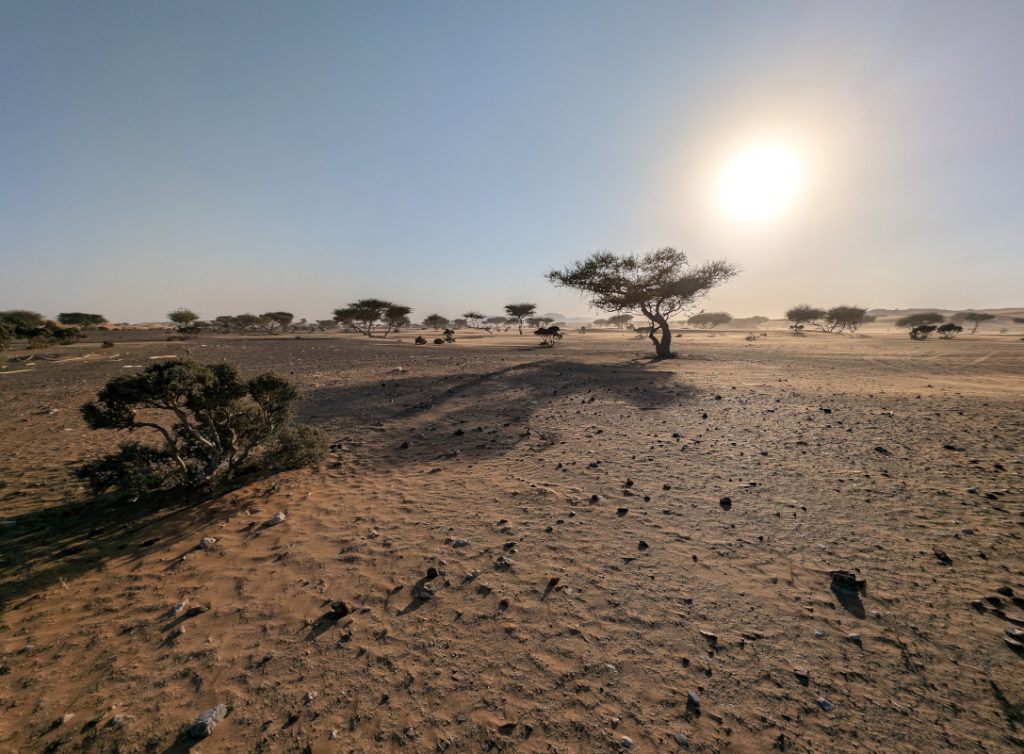
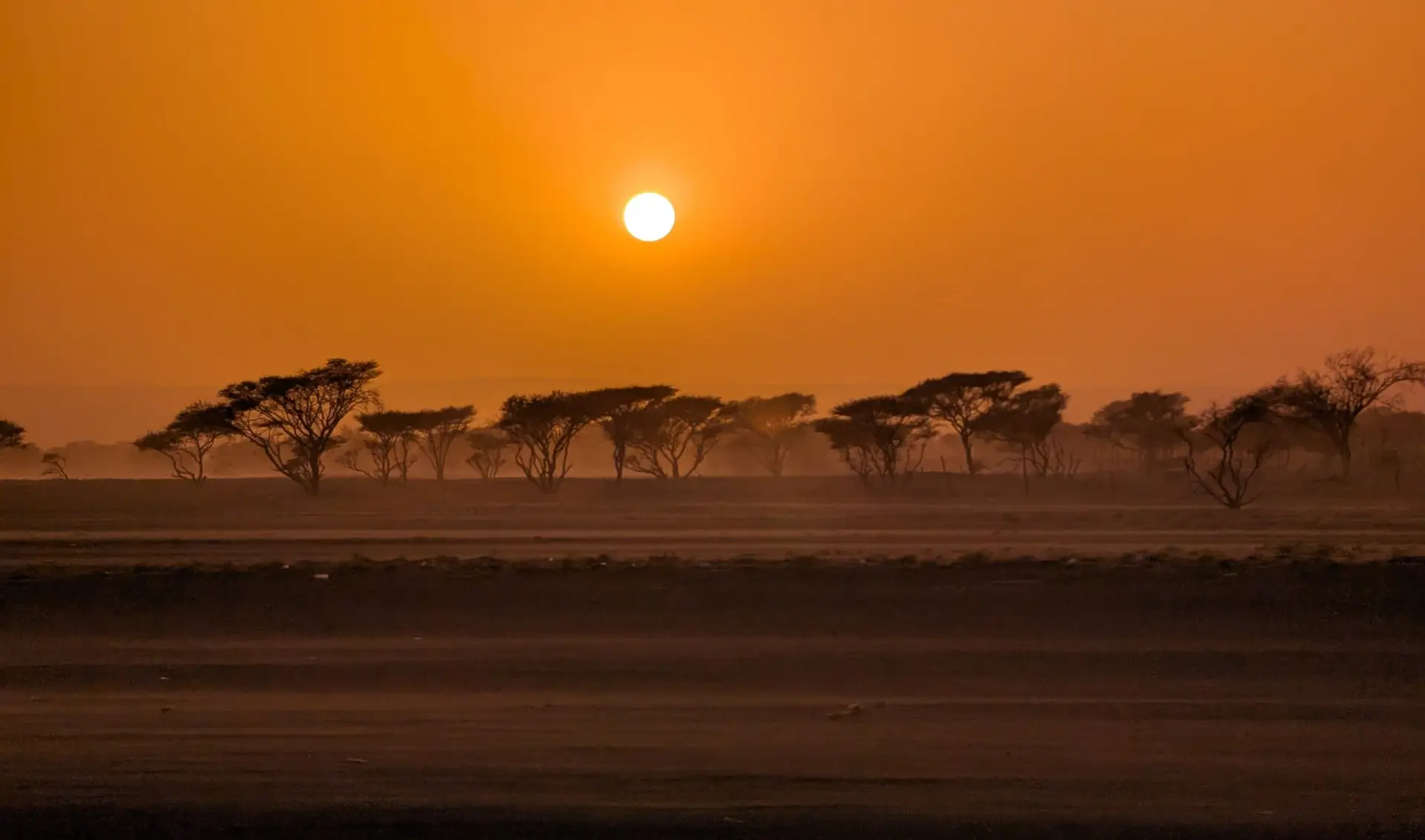
A group of Vachellia tortilis in the sunset, desert of Al Muntarib, Oman.
Facebook
LinkedIn
X
Email
WhatsApp
This article was originally published in the Mandragora Digital Bulletin #5.

Note about taxonomy

As a result of phylogenetic studies, a reclassification of the genus Acacia was proposed in 2003 and, after the usual intense debate, was finally approved at the 17th International Botanical Congress in 2011. Since then, taxonomy reserves the genus Acacia principally for those species native to Australia, which comprised the majority in the previous classification and around 1100 species in the current. Acacias native to Africa and the Middle East were reclassified into the genera Vachellia and Senegalia, both adding up to approximately 350 species [1].

Previous publications, like the 2008 paper by Benny Shanon we will discuss below, referred of course to Acacia sensu lato. In this article, and since the species we will principally talk about (like Vachellia tortilis, formerly Acacia tortilis) were affected by the change, either the old or the new nomenclature will be used depending on context. Our genus abbreviations correspond to A.=Acacia, S.=Senegalia and V.=Vachellia. Still, following colloquial language, we may also use the generic, non-scientific “acacias” to refer to the group of African and Middle Eastern species that taxonomy now classifies as Vachellia or Senegalia.

From the Amazon to Sinai

“The ideas entertained here were primarily based on the fact that in the arid areas of the Sinai peninsula and Southern Israel there grow two plants containing the same psychoactive molecules found in the plants from which the powerful Amazonian hallucinogenic brew Ayahuasca is prepared. The two plants are species of Acacia tree and the bush Peganum harmala.” [2]

The quote above belongs to a 2008 paper written by Benny Shanon, professor of psychology at the Hebrew University of Jerusalem who sadly passed away last year. In this paper he proposed the idea that “the ancient Israelite religion was associated with the use of entheogens (mind-altering plants used in sacramental contexts)”.

Even though Shanon himself called it a speculative hypothesis, the idea was immediately adopted by a growing audience interested in ayahuasca, the epitome of the visionary brew and a key influence in the recent (re)discovery of shamanic practices in our culture. The association of ancient mystical experiences and theophanies with the hypothetical use of psychoactive plants was nothing new, but the link to the Hebrew tradition, together with the wide geographical distribution of the plants on which Shanon based his hypothesis, ignited speculations and even emboldened others to project this new “ancient entheogen” to other locations across a major historical landscape, from Ancient Egypt to Sumer and beyond. In the last year alone, we have continued to come across comments, articles and even courses and presentations which, whether consciously or not, are based on Shanon’s paper. This seems enough to motivate a closer look into the data it presents; but scrutiny aside, here’s a story where our different notions of myth—as ancient tale, misconception, popular belief or even imaginary element—converge. To which we’d like to add a reflection on what may grant a tree the status of sacred.
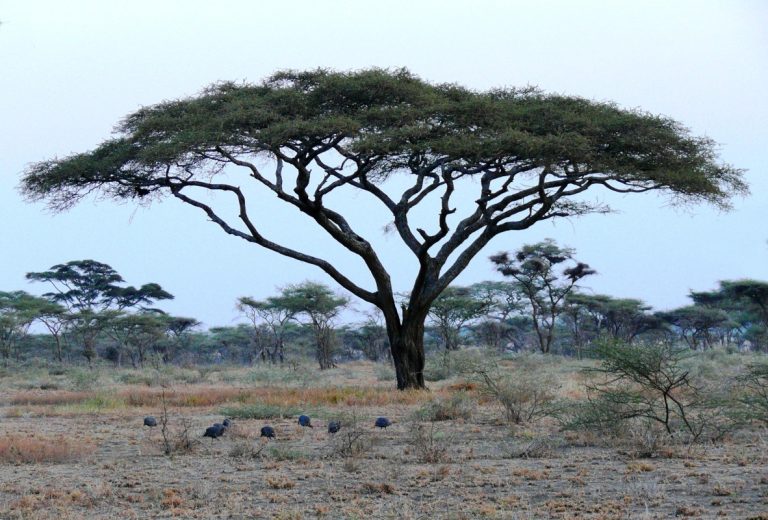
The Umbrella Acacia, Vachellia tortilis.
The Umbrella Acacia, Vachellia tortilis. Photo by Haplochromis (2009). CC BY-SA 3.0

Before addressing Shanon’s ideas, we should set the stage with a quick overview of what originally inspired them: the ayahuasca brew, and specifically its principal ingredients.
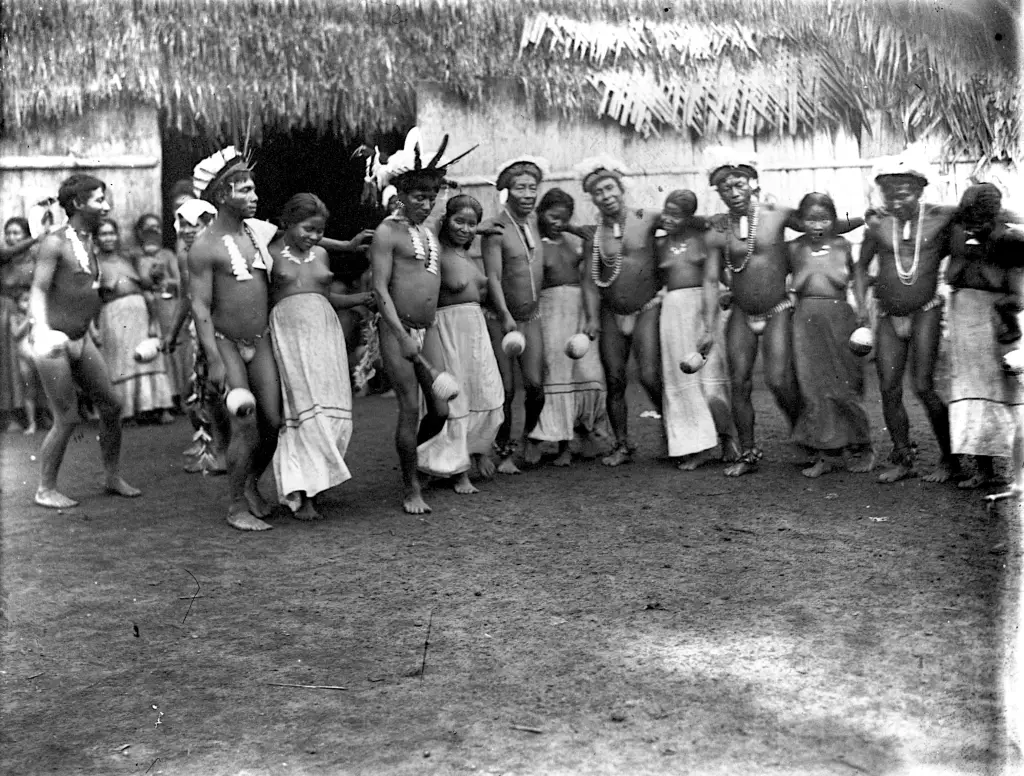
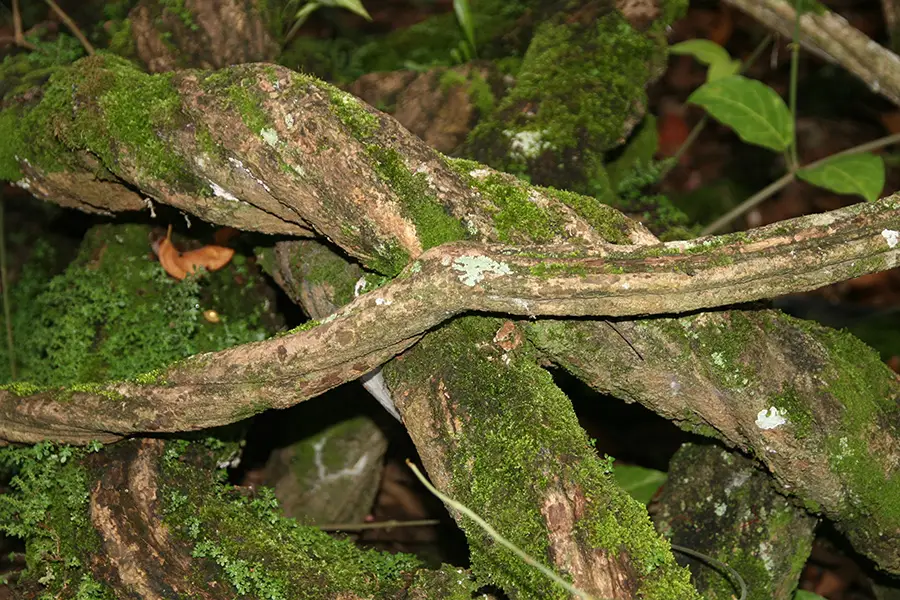
Ayahuasca is a rich and complex tradition, practised by around a hundred indigenous groups in the Amazon. In different languages it is also called yagé, caapi, nixi pae, camarampi or natem—up to 42 different names for it were already listed by Luis Eduardo Luna forty years ago [3]. Its antiquity is unknown and archaeological evidence, scarce and particularly challenging in rainforest environments, is still being elucidated [4]. Although there are historical accounts from Spanish and Portuguese Jesuits referring to it as early as the 17th century, the first important report including a formal identification of the main plant involved, the Banisteriopsis caapi vine, was provided by Richard Spruce, an English botanist who first witnessed an ayahuasca ceremony among the Tukano in 1852. Nearly a century later, Harvard botanist Richard Evans Schultes first encountered ayahuasca in the Putumayo region, Colombia, in 1941. His reports spanned over a decade and arguably became the foundation for modern ethnobotanical and pharmacological studies about the brew and its ingredients [5].
Tucano people dancing during a celebration, near Rio Vaupés (1923-1926)
Tucano people dancing during a celebration, near Rio Vaupés (1923-1926) Photo by Douglas Melin. Swedish Museum of Natural History. CC BY-SA 4.0
Although there may be as many variations of ayahuasca as individual traditions, the quintessential modern brew is prepared with some variety of the Banisteriopsis vine and one “admixture” plant, usually the leaves of Psychotria viridis Ruiz & Pav., a bush in the Rubiaceae family, or alternatively of Diplopterys cabrerana (Cuatrec.) B. Gates. The vine contains psychoactive beta-carboline alkaloids like harmine, harmaline and tetrahydroharmine, while both P. viridis and D. cabrerana are rich sources of N,N-dimethyltryptamine (DMT), a very potent visionary compound. One issue with DMT is that, if ingested orally, it is quickly metabolised by the monoamine-oxidase (MAO) enzymes in our digestive tract, and thus prevented from reaching systemic circulation to produce its powerful effects. Here’s where the remarkable wisdom (communicated by the plants themselves, a practitioner will say) in ayahuasca recipes plays out: the beta-carboline alkaloids from the vine do not only elicit in themselves significant psychoactive effects, but also, by temporarily blocking the MAO enzymes, they permit DMT to work. The synergy between phytochemical compounds, along with the ritual aspect in ayahuasca, result in profound, paradigm-shifting and potentially healing visionary experiences, with a deep personal and often spiritual meaning for the participant.
Ayahuasca vine (Banisteriopsis caapi), Takiwasi Center botanical garden. Photo by François Delonnay (2007). CC BY-SA 4.0
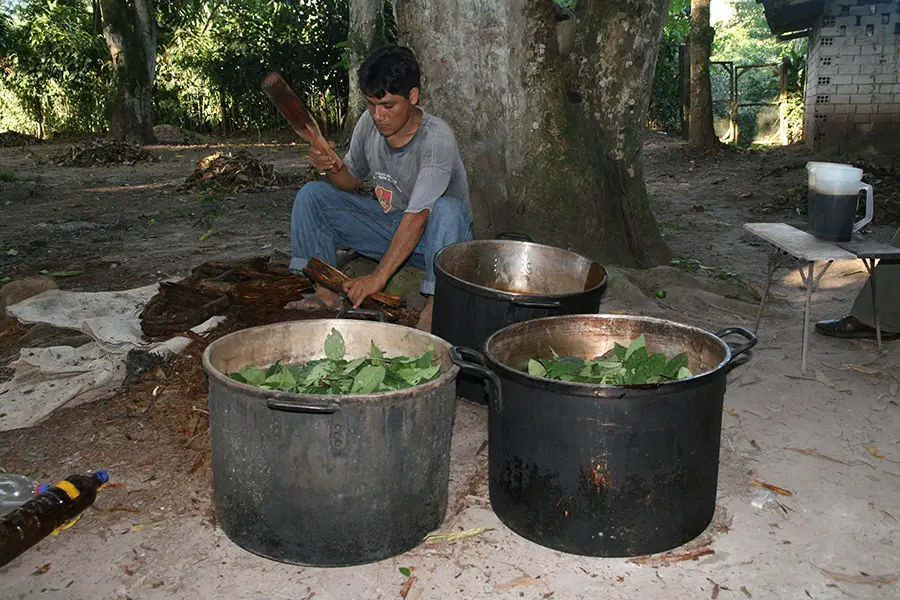
Preparation of ayahuasca (Banisteriopsis caapi) and chacruna (Psychotria viridis) for a brew in the Takiwasi Center, Perú. Photo by François Delonnay (2007). CC BY-SA 4.0
This understanding of the pharmacology of ayahuasca brews, and the progressive discovery of the same (or very similar) psychoactive compounds in other plant species around the world, allowed for the exploration of ayahuasca analogues (see Ott, 1994). That is, preparations based on the same synergies found in Amazonian ayahuasca brews, but using different plant sources. Most notably, the beta-carboline alkaloids produced by Banisteriopsis can be found, in even higher concentrations, in Peganum harmala L., known as Syrian rue or harmal, the Mediterranean bush where harmine and harmaline were first isolated [6] and also the source of their names. While DMT, on the other hand, occurs surprisingly often in the plant kingdom, it rarely appears in concentrations high enough (and clean enough) to make a plant species a suitable ingredient for a potent visionary drink. The most fruitful family in this sense seems to be Fabaceae—the legumes—where Mimosa tenuiflora (=hostilis) (Willd.) Poir., a small tree or shrub found in Brazil and Central America, has so far been the most known and reliable plant source of DMT. It is also the protagonist of its own visionary ceremonies and tradition in northeastern Brazil. And in the same plant family, a group of trees and shrubs known to produce significant amounts of tryptamine alkaloids are the acacias. The first species in the genus where DMT (together with NMT, N-methyltryptamine) was identified was Acacia maidenii F.Muell., in 1965 [7]. Since then, it has also been found in meaningful amounts principally in species native to Australia.
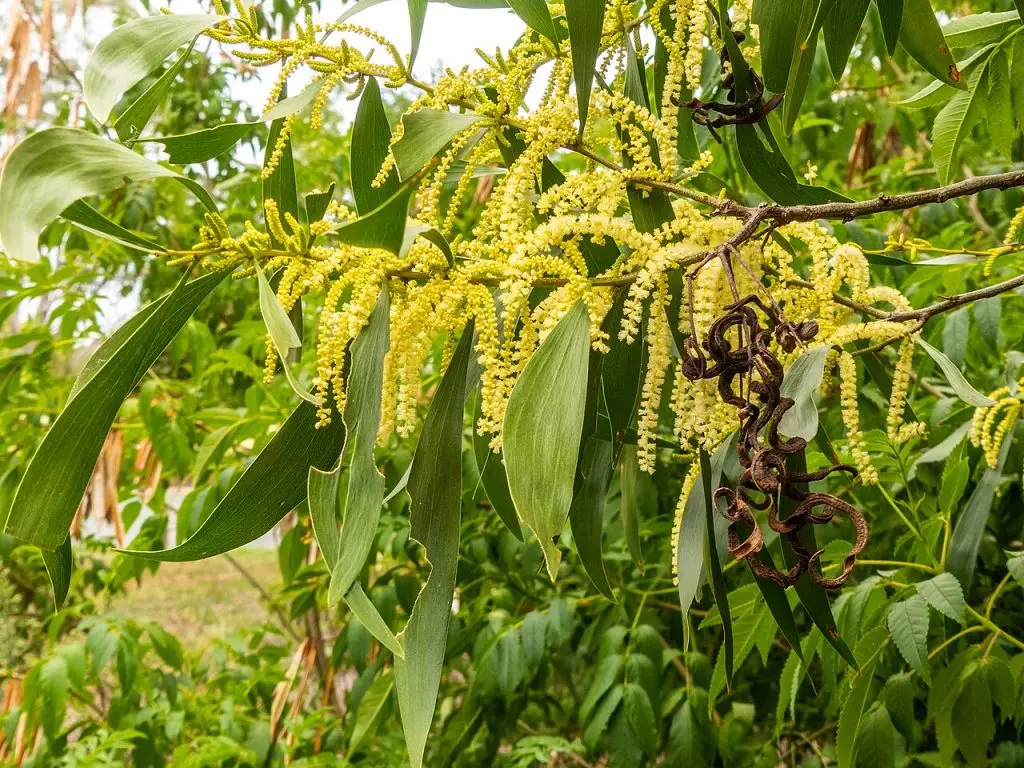
Acacia maidenii inflorescences and legumes. 7th Brigade Park, Chermside. Photo by John Robert McPherson (2026).
The effects (particularly the visions) induced by taking DMT alone, usually vaporised, are short-lived but intense and potentially mind-blowing. This is hardly an overstatement and it can be taken quite literally, as anyone who has experienced its effects will attest to. Ayahuasca is able to provide a less sudden yet much longer experience. Its synergistic wisdom has sometimes led to an interpretation according to which the point of the brew is “allowing DMT to work orally”. This is however a rather reductive description, partly the result of our own cultural gestalt. Modern civilisation produces eminently visual humans more susceptible to awe and revelation when visions appear, either with eyes open or closed. Indigenous shamans have doubtless taken this into account, perhaps increasing the proportion of vision-intensifying plant admixtures for foreigners to heighten the experience’s appeal—yet this is only part of its magic.
In any case, over the last decades all sorts of explorers, including researchers in different disciplines, have been drawn to ayahuasca and have produced an enormous amount of literature about it. One of them was Benny Shanon, who, following his studies of consciousness, encountered ayahuasca in the Amazon in the early 90s and, of course, was profoundly impressed [8]. Surprised by the similarities between the visions he experienced and those reported by indigenous people, he launched a pioneering cognitive-psychological study of ayahuasca; drawing from interviews and from his many personal experiences with the brew, he published the interesting monograph The Antipodes of the Mind [9]. There he reports, as one main finding, that “Ayahuasca visions exhibit significant inter-personal commonalities that defy socio-cultural variations” [10].
Inevitably, Shanon’s Jewish heritage was present in his own experiences and subsequent reflections, which necessarily contributed to the formulation of the “biblical entheogens” hypothesis, that he developed later on and that concerns us here. In the text, he proposes a series of considerations to support it—some of which we will discuss later—drawing from “comparative experiential-phenomenological observations, linguistic considerations, exegesis of old Jewish texts and other ancient Mideastern traditions, anthropological lore, and ethnobotanical data” [11]. The hypothesis is principally articulated around the book of Exodus, including Moses encountering the burning bush, the theophany at Mount Sinai, the construction of the Tabernacle (essentially, a tent-like sanctuary meant as a dwelling place for God during the journey of the Israelites through the desert) and the Ark of the Covenant, where the tablets inscribed with the ten commandments received from God were to be stored and transported.
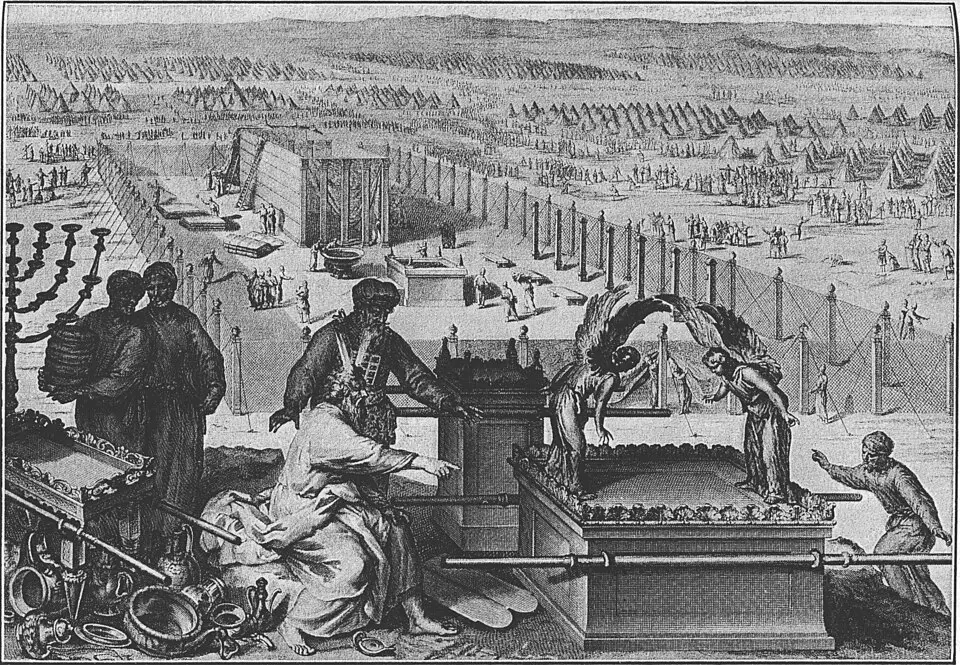
The erection of the tabernacle and the Sacred vessels, as in Exodus 40:17–19; from Figures of the Bible (1728)

Interdisciplinary work can be a daunting task for any author; addressing each and every observation Shanon made to corroborate his hypothesis is not the aim of this article. Some of his suggestions, like the proposal that the bush in flames (yet not burning) where Moses encountered God, or God’s manifestations in Mount Sinai were the result of mind-altering substances, could be applied to virtually any account of mystical visions or experiences throughout history. Although, keeping ayahuasca in mind, Shanon does elaborate in detail: for instance, about how the appearance of God is preceded by three days of purification and sexual abstinence by the Israelites, which he connects to the usual fasting requirements before an ayahuasca ceremony (overlooking the fact that purification and sexual abstinence are commonplace in ritual preliminary work in multiple traditions); or the transformation of a staff into a snake, which Shanon notes as a common, recurring element in ayahuasca visions (but the serpent is an important, nearly ubiquitous symbol in myths and sacred scriptures, related or not to psychoactive substances).

The argument that interests us most here is precisely the one on which, as stated in our first quotation, Shanon primarily bases his hypothesis: ethnobotanical data.

There are many varieties of the tree [acacia], and it grows not only in the Sinai desert, but also in Australia, Mexico, and South America. Subspecies [sic] growing in the Sinai peninsula and in the Negev desert of southern Israel and containing DMT are Acacia albida (Mimosaceae), Acacia lactea [sic] (Mimosaceae) and Acacia tortilis (Mimosaceae). Also containing DMT are Acacia seyal (Mimosaceae) and Acacia nilotica (Mimosaceae), which grow in Egypt (see Shulgin and Shulgin, 1997). Feliks (1997) proposes that the biblical shittim is Acacia albida; Duke (1983) associates the shittim with Acacia seyal. However, Danin (personal communication), the present-day leading expert on the plants of the Land of Israel, has pointed out to me that neither of these plants grows in the Sinai peninsula. (…) Thus, the most likely candidates seems to be Acacia tortilis and Acacia lactea [sic]. In sum, while the particular identification of the biblical tree might be unsettled, it is a fact that some acacia subspecies that grow in the region do contain DMT. [12]
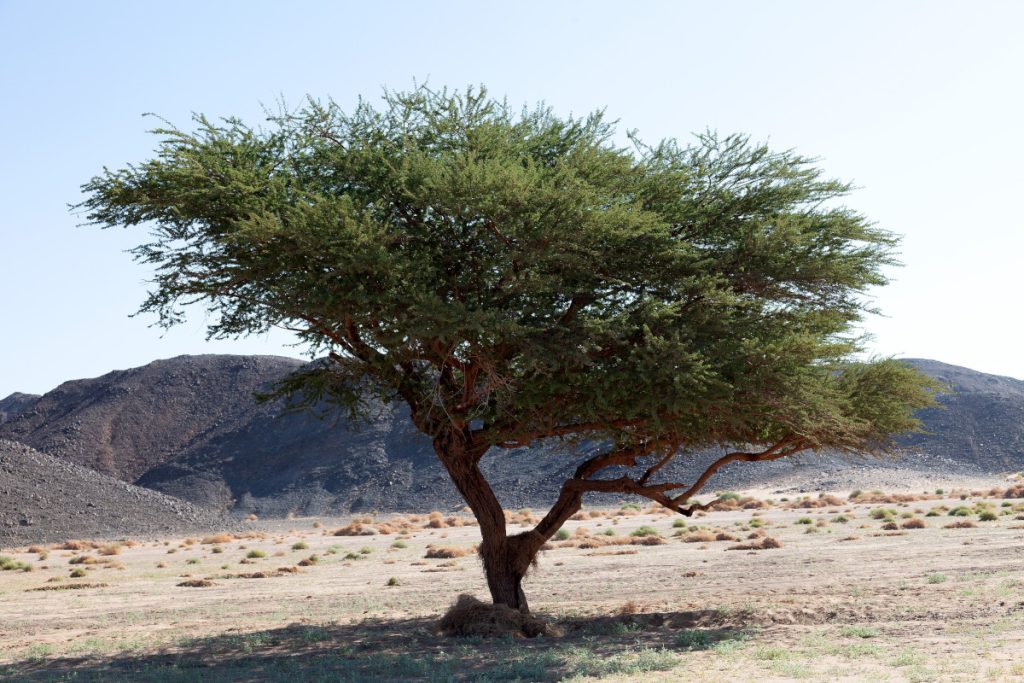
Shittim is the name used in the scriptures and Hebrew tradition in general to refer to the desert acacia trees whose wood is mentioned in Exodus, and that we will discuss later. In this quote, we assume that Shanon proposes as its candidates A. (currently Vachellia) tortilis and A. (currently Senegalia) laeta, and not “lactea”. If we continue to base our guess on recent distribution maps [13], we could further narrow down the identity of the tree to V. tortilis, since S. laeta is presently not reported in the Sinai peninsula.
Vachellia Tortilis in the north of Wadi Naʿam, Eastern desert, Egypt. Photo by Roland Unger (2015). CC BY-SA 4.0
In his article, Shanon naturally also discusses the other factor in the analogue equation, Peganum harmala [14]. While, as he notes, there is no mention of harmal in the Bible, the use of the plant in medicine and magic and its properties are widely documented from the Western Mediterranean to the Middle East. At this point, even though there’s no evidence whatsoever of the use of any “ayahuasca analogue” in the ancient history of the Near East (there’s “no smoking gun”, as Shanon himself admits), the stage is set. With the presence of DMT in all these acacia species, and the indisputable value of P. harmala in the pharmacological role of B. caapi, the biblical entheogens hypothesis was seductive enough to spread—and not only promoting idle speculation in people interested in psychoactives or the ancient world. Some conjectures were subsequently elevated to fact even by academic sources. One example was reported by our collaborator Rafael Sacramento: in Spain, Dr. Eduardo Carlos González Wagner, an Ancient History professor from the Universidad Complutense de Madrid, claimed in a text written for his 2012 presentation at the congress El Tiempo y la Momia (Time and the Mummy) that “some subspecies that grow in the Sinai desert and Negev, like Acacia albida, Acacia lactea and Acacia tortilis contain DMT, and also Acacia seyal and Acacia nilotica which grow in Egypt” (Wagner 2012). The same claims, which as we see reproduce verbatim errors in Shanon’s original article, were also repeated in his presentation at the 2014 conference “Science and Technique in Ancient Egypt” (Wagner 2014). At least some of the statements we’ve found over the last decade regarding “DMT in Ancient Egypt” must have the same origin.

But making ethnobotanical data the cornerstone of a speculative hypothesis without conducting a thorough review of its sources is a bold move. We can understand Shanon’s audacity, however, when he wrote “it is a fact that some acacia subspecies that grow in the region do contain DMT”; especially because he relied on information provided by a source that, admittedly, was as authoritative as it gets when it comes to psychedelic compounds: Alexander Shulgin.

A Misunderstanding behind the Myth

DMT is everywhere, is how Shulgin named one of the chapters of his book TiHKAL, The Continuation, dedicated to the many sources of psychedelic tryptamines in plants, fungi and even animals. Of course the title is an overstatement, but if you are somewhat familiar with the Shulgins’ work (if you are not, there is an introduction in the second issue of our digital publication), you will know that their masterpieces PiHKAL and TiHKAL are unique in their scope and perspective, with neither content nor structure accommodating academic literature protocols.

In this chapter, and after a mention of Acacia maidenii, the first member of the group where DMT made an appearance, Shulgin wrote:

There is DMT (or NMT, or T) reported in the following Acacia species: A. albida (DMT, in the leaf), A. confusa (DMT and NMT, in the leaf, stem and bark), A. cultriformis or Golden Glow or Knife-leaf Wattle (T, in the leaf and stem), A. laeta (DMT, in the leaf), A. mellifera (DMT, in the leaf), A. nilotica (DMT, in the leaf), A. phlebophylla or Buffalo Sallow Wattle (DMT, in the leaf), A. podalyriaefolia or Mt. Morgan’s Wattle, or Queensland Silver Wattle (T, in the leaf), A. polyacantha (DMT, in the leaf), A. senegal (DMT, in the leaf), A. seyal (DMT, in the leaf), A. sieberiana (DMT, in the leaf), A. simplicifolia (DMT and NMT, in the leaf, stem and trunk bark), and A. vestita or Hairy Wattle (T, in the leaf and stem). [15], [16]

Shortly after this, Shulgin also adds a comment about an Acacia story that
… deals with the acacias that are found in, and identified with, the ancient history of the Near East and Egypt. There was a balsam oil peddled to the priests of yore by the Bedouins, which was claimed to have come from the “original” “Tree of Knowledge”, which existed at the lowest point on earth, near the Dead Sea and the Sinai Desert. This balsam oil was made from the A. tortilis, or the Umbrella Acacia. [17]

In his seminal classics PiHKAL and TiHKAL, Shulgin did not use source references in chapters about psychoactive substances because he essentially drew from his own extensive self-experimentation and laboratory notebooks. This logic also reached his discussion about plant sources of tryptamines, which was based on existing research from third parties, yet references were not provided. In this particular case, however, it seems very likely that the original source had to be the only paper previously published concerning the presence of DMT in some African and Middle Eastern Acacia species, an article from 1975 that may be at the origin of historical confusion. It is unclear if Shulgin himself misunderstood the paper, which is unlikely given his expertise in chemistry, or if it was cited by someone else second hand and Shulgin simply never verified the source directly.
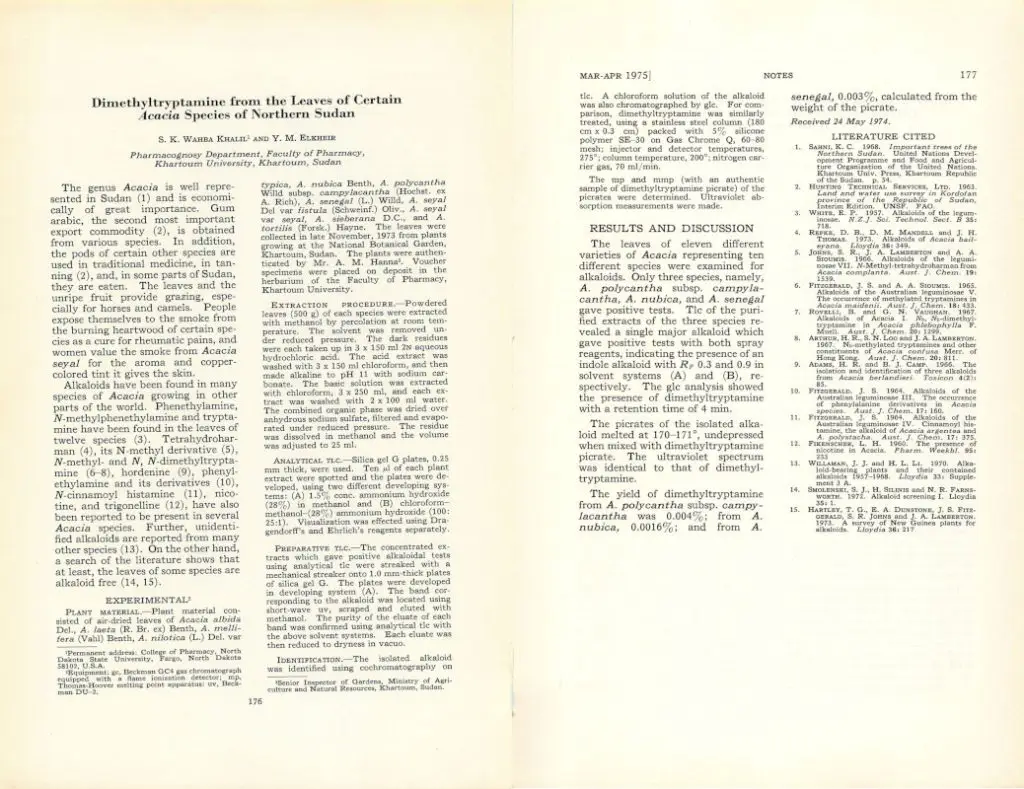
Small reproduction of the 1975 paper in question, from a copy kindly provided by Keeper Trout
Small reproduction of the 1975 paper in question, from a copy kindly provided by Keeper Trout.
This paper was named “Dimethyltryptamine from the leaves of certain Acacia species of northern Sudan” [18], a title that, considering the results it shared, is rather sensationalistic even if technically correct. It was produced in the Faculty of Pharmacy at the University of Khartoum, and published in 1975 in Lloydia, a journal by the Lloyd Library and Museum and the American Society of Pharmacognosy. In the study, probably encouraged by several findings of DMT in Acacia species from Oceania and Southeast Asia, the dry leaves from a list of the Acacia species found in Northern Sudan (and also present, among other acacias, in regions from Southern Africa to the Middle East) were screened for alkaloids. Specifically: A. albida Del., A. laeta R. Br. ex, A. mellifera (Vahl) Benth., A. nilotica (L.) Del. var. typica, A. nubica Benth, A. polycantha [sic] Willd subsp. campylacantha (Hochst. ex A. Rich), A. senegal (L.) Willd, A. seyal Del. var fistula (Schweinf.) Oliv., A. seyal var. seyal, A. sieberana [sic] D. C., and A. tortilis (Forsk.) Hayne.
This list almost completely matches Shulgin’s (and, most importantly, Shulgin’s matches Shanon’s), if we discount the other species he included from other parts of the world where DMT has been consistently found, like A. confusa, A. phlebophylla or A. simplicifolia. Shulgin also stated that DMT had been found “in the leaf” of all of these African species, which is precisely what the Sudanese study screened and explicitly mentions in the title. So it seems reasonable to assume that this paper was, directly or not, Shulgin’s source.

But the problem is precisely in the results reported in the paper:

The leaves of eleven different varieties of Acacia representing ten different species were examined for alkaloids. Only three species, namely, A. polycantha subsp. campylacantha, A. nubica, and A. senegal gave positive tests (…) the yield of dimethyltryptamine from A. polycantha subsp. compylacantha was 0,004%; from A. nubica, 0,0016%; and from A. senegal, 0,003%. [19]

Not only was DMT detected in only three of the eleven varieties (one of them being A. nubica, curiously the one missing in Shulgin’s list) but the concentrations were also very small, below the threshold that phytochemical research usually considers “traces”. For comparison, to obtain the same amount of DMT contained in around 10 g of Psychotria viridis leaves (roughly equivalent to an average ayahuasca dose), one would need more than 1.5 kg of A. senegal leaves. [20]

And no alkaloids were found in the other eight species, including the two that Shanon considered candidates for the identity of the biblical shittim, A. laeta and A. tortilis. Apparently, someone misread the 1975 paper, and that caused a chain of unfounded assumptions that persist to this day.

While this alone dismantles the central argument for the biblical entheogens hypothesis at the time it was proposed, we wanted to check the information against more recent publications and have carried out a review of recent literature concerning properties and phytochemical analysis of all the species mentioned by Shanon in his article. This review, conducted by Rafael Sacramento, is too extensive to include here and will be made available as an appendix. Just to quote some of its concluding remarks,

while some selected species did show the presence of tryptamines, the majority of species did not, and in the few selected instances when these compounds were present, they were only found in trace amounts. Contrary to the Acacia sensu stricto genus, where we see several species with significant amounts of DMT and other psychoactive tryptamines (Donavan et al 2025), in the case of Senegalia and Vachellia we were unable to find any evidence of significant psychoactive tryptamines. (…) New future research shedding new light on this question could shift the conclusion to a different direction, but for the moment, we must consider these claims to be unfounded and seemingly based on misunderstandings from old publications or unlikely hypotheses based on weak evidence.
An exhaustive review with similar aims had been conducted in 2022 by Nicholas Sadgrove, from the University of Johannesburg in South Africa [21], who also recently published another paper reporting findings of small amounts of DMT in a different African species, S. ataxacantha [22]. In the same study, V. tortilis was once again screened and no tryptamine alkaloids were found. Until further notice, and with no need to invoke additional argumentation, speculations about biblical analogues of ayahuasca can be put to rest.

Nonetheless, the special consideration that desert acacias have received remains. With or without visionary substances in them, people in arid regions of North Africa and the Near East had regarded these trees as special, even sacred in very ancient times—and that is indubitably a fact.
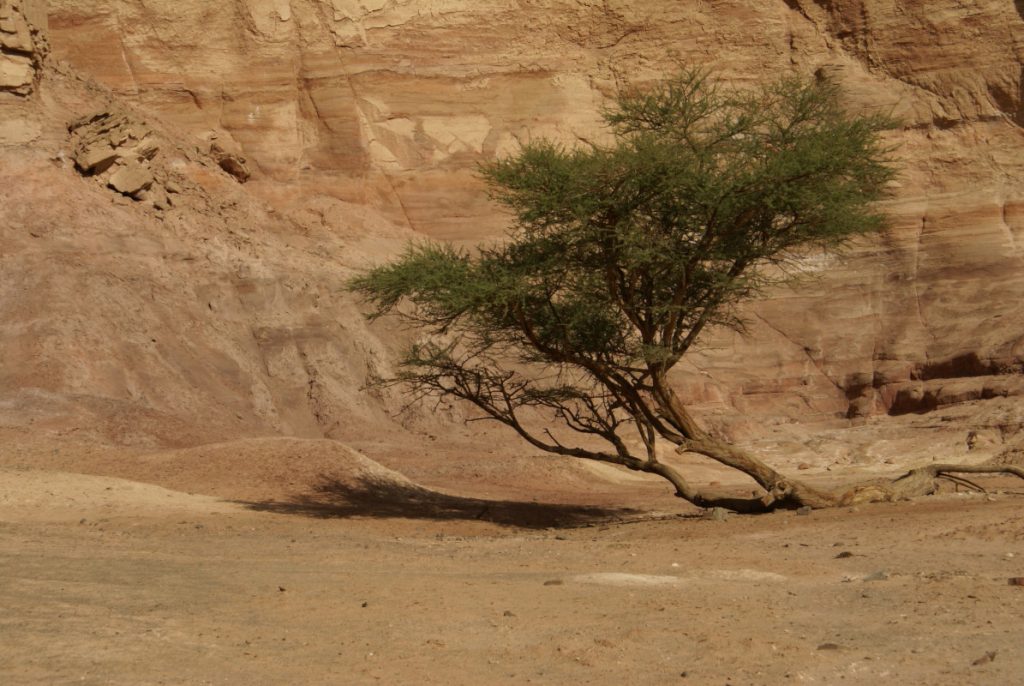
An acacia, probably V. tortilis, growing in a valley on the Sinai Peninsula. Photo by Florian Prischi (2007). CC BY-SA 3.0 license

The Sacred Acacia

Sacred trees, groves or even whole forests have manifested in nearly every culture. As we will see, however, this sacred dimension has been interpreted differently, if recognised at all, depending on worldviews and religious beliefs. The differences between what in the West has been called natural religion (based on observation of the cosmos, and thus universally available) and revealed religion (derived from divine communication usually represented in sacred texts) become particularly relevant here. Amazonian indigenous religions fit our concept of the former; Abrahamic religions fit the latter.
But what is sacred?
As a practical definition [23] we could say that sacred trees are trees subject to worship and/or veneration not necessarily practised with others. Among cultures following revealed religion in our European/Mediterranean territory (principally Abrahamic religions: Judaism, Christianity and Islam), “sacred” is not a word applied lightly; the reasons why trees may be considered particularly blessed are specific and chiefly associated with other, officially sacred elements in the religion: trees that are connected to saints, or perhaps mark the path to a sacred site [24]. Reasons other than correlation with places or personalities in the faith (for instance, virtues or attributes of the tree in itself, like its fruits, size or the shade it provides) are, unsurprisingly, more likely to appear among groups that live intimately connected to the environment, like Bedouins in the case of Islam; these other reasons of course proliferate in cultures closer to a natural religion worldview [25].
In the context of Abrahamic religions, specific tree individuals may be considered blessed but we haven’t identified any tree species that, as a whole, have been religiously blessed. One exception could be Ziziphus spina-christi (L.) Desf., a thorny evergreen native to the Levant and Mesopotamia, whose branches, according to some, formed the crown of thorns Jesus wore in the Passion (although others proposed it was made with one of our thorny acacias). In the case of Judaism, there’s good evidence to suggest that ancient temple incenses and anointing oils, particularly thanks to Boswellia resins, had psychoactive qualities. However, there’s no evidence of any tree species being assigned a special spiritual role due to psychoactive or otherwise remarkable powers. Shittim was no exception, and the prominence it was given in the construction of artifacts in Exodus was likely due to more practical considerations.
The Hebrew word shittim (שִׁטִּים) literally translates to “acacias”, as the plural form of shittah (שִׁטָּה), which means acacia tree. In his hypothesis, Shanon offered an etymological suggestion from Talmudic interpreters that relates shittah to the word shtut (nonsense) [26], which would conveniently evoke the alleged mind-altering properties of the species. The consensus among linguists according to multiple sources, however, seems to point elsewhere. Shittah is more likely to be a loanword from Ancient Egyptian referring precisely to acacia trees, or to derive from a Hebrew root referring to their scourging thorns or simply wooden sticks.
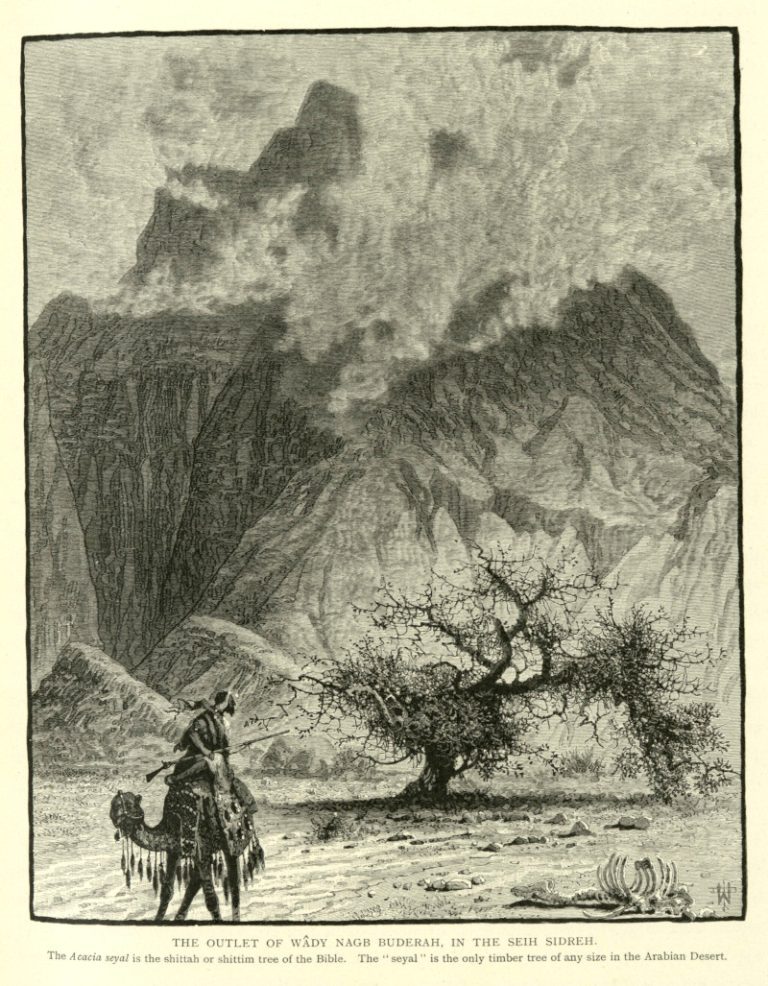
"The outlet of Wâdy Nagb Buderah, in the Seih Sidreh". The source identifies the shittim tree as A. seyal, "the only timber tree of any size in the Arabian Desert".
"The outlet of Wâdy Nagb Buderah, in the Seih Sidreh". The source identifies the shittim tree as A. seyal, "the only timber tree of any size in the Arabian Desert". Illustration by John Douglas Woodward, c.1881. Digital collection of the New York Public Library.
Since the name shittim is generic, there’s the possibility that V. tortilis was not even the wood used by the people of Moses. Studies on the structure of the Tabernacle, the tent system used as portable worship centre by Israelites in the desert, have suggested that other species that could occur in Sinai, like A. albida (presently Faidherbia albida), seemed more likely candidates since V. tortilis would be too small for the size of Tabernacle poles [27]. In any case, Exodus 37 and 38 tell us how shittim wood was explicitly requested by God (along with gold, silver, brass, animal hides and linen) to craft the board, table and poles for the Tabernacle, the pillars to hang its door, the altar, the ark and the staves to carry it. Rather than shittim being psychoactive, it was likely chosen because it was available in the area and especially because the properties of the wood made it durable and capable of withstanding the elements.
Desert acacias grow slowly. They thus produce dense and hard wood that is very resistant, naturally protected, thanks to its own resins, against insects, fungi and humidity, and offering an attractive dark red hue once polished. Even nowadays, desert peoples use boards made of acacia wood—easy to wipe clean and re-utilise—to write praises and religious verses, and in ancient times it was often used in Egypt for a variety of applications, including the construction of boats, a use that persists in the Nile basin to this day [28].
Easy to spot in the wilderness due to their flat tops, desert acacias can grow where very little else does. Trees like S. laeta, V. seyal, V. tortilis and its subsp. raddiana (one of the most resistant to extreme drought in the whole family) are considered keystone species in African deserts, the Negev and other arid environments in the Middle East. This is a category reserved to species that have an enormous, vital impact on the ecosystem, and it’s not surprising that they could be sanctified by nomadic desert peoples; talh trees, the common name used for them in Arabic, are a very beneficial ally. Bedouins can use them for wood and valuable resins if needed, a grazing spot for animals, shade (and its importance in the desert can hardly be overstated) and see them as indicators and creators of life under their canopy; research has confirmed the importance of acacia trees “for maintaining spatial heterogeneity by creating nutrient-enriched patches in the nutrient-poor desert environment, leading to higher species diversity in the region” [29]. This is in fact a common trait in sacred groves even outside arid ecosystems; they act as centres for biodiversity conservation, and stewardship groups recognise them as such and establish rules for their protection [30].
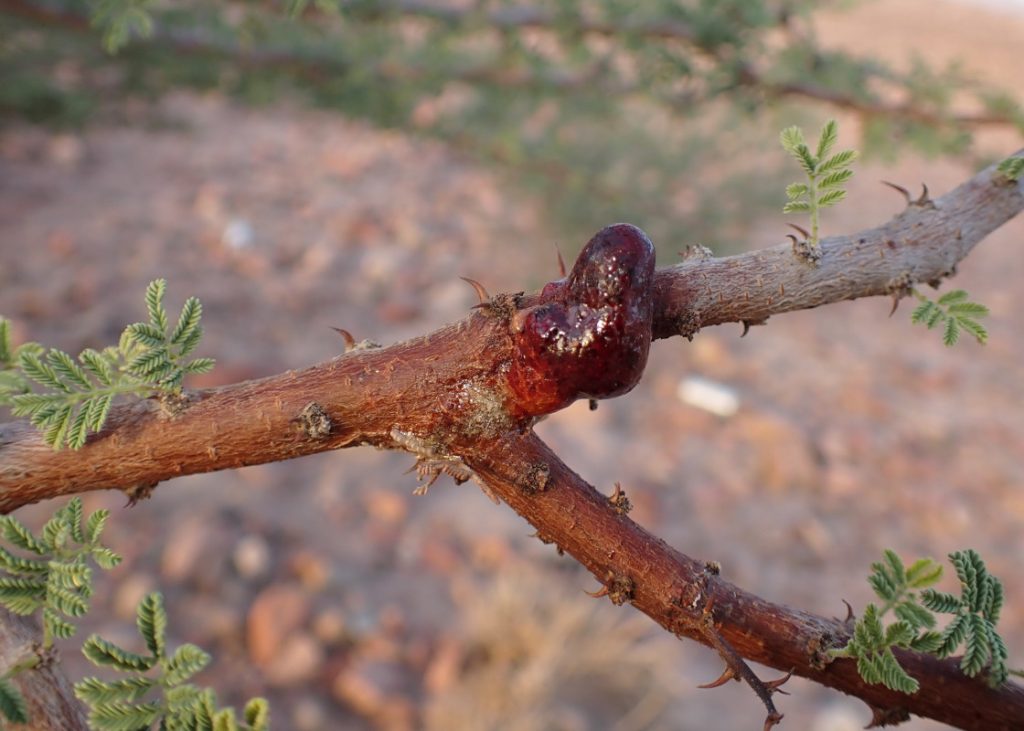
Resin exudating from Vachellia tortilis
Resin exudating from Vachellia tortilis in Akaba, Jordan. Photo by Krzysztof Ziarnek (2023). CC BY-SA 4.0
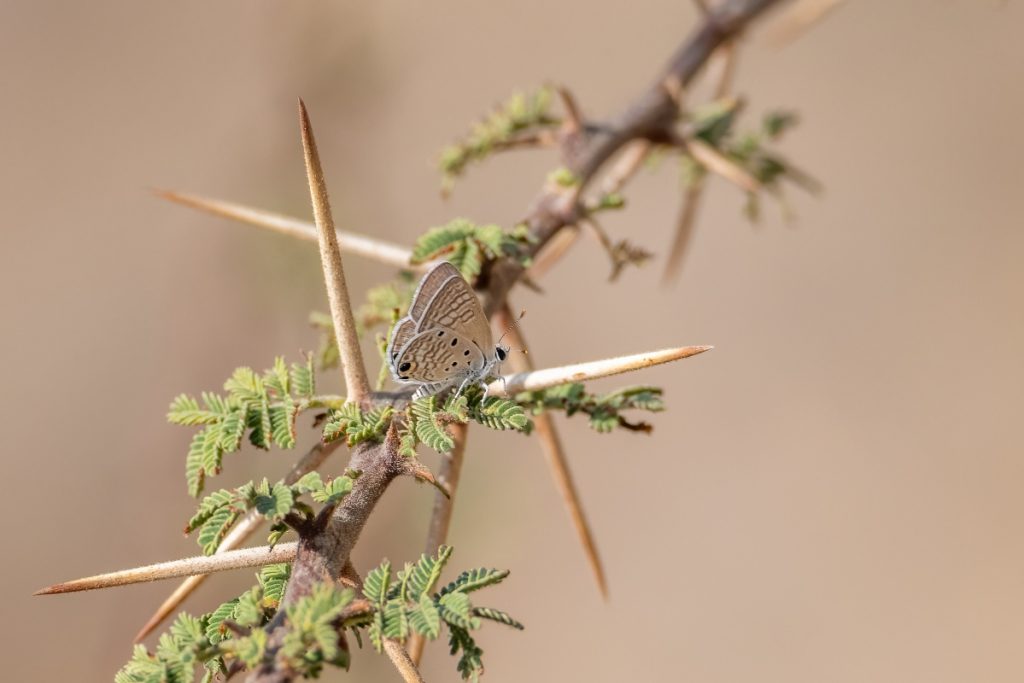
Anthene amarah ssp. turlini butterfly on Vachellia tortilis.
Anthene amarah ssp. turlini butterfly on Vachellia tortilis. Photo by AmethystDreams (2025). CC BY-SA 4.0
While the status of trees as givers of life can be partly explained by the layer of leaves they deposit in the soil, protecting it and providing it with nutrients, for many cultures outside the desert, there are far deeper reasons than that. Trees can often have a much longer life span than humans. Ancient cultures saw generations come and go, all benefitting from the shade of the same tree, that earned the same respect as elders among men. The perception of trees as symbols of immortality may be at the origin of their worship [31]. Acacias were “trees of life” in ancient Egypt, present in legends around death and the afterlife. Studies in modern populations of V. tortilis in the hyper-arid Eastern Desert of Egypt have measured ages of between 200 and 650 years [32], and it’s not unreasonable to suppose that individuals in ancient times, and growing in less extreme environments, could have easily lived for longer.
Vachellia tortilis in Masjid, Oman.
Vachellia tortilis in Masjid, Oman. Photo by Krzysztof Ziarnek, Kenraiz (2025). CC BY-SA 4.0
It has also been suggested that there is a connection between trees, “a form of nature that represents life and the sacred continuity of the spiritual, cosmic and physical worlds” [33], and the veneration of ancestors, probably one of the oldest religious forms. In seeing trees as witnesses, mediators and links to the afterlife, cultures practising polytheism and veneration of ancestors could consider all individual trees in a species to be religiously sacred. This has been documented among peoples of Equatorial Africa, India, Tibet, the Pacific islands and Native American nations, among others [34]. Even in ancient Greece and Rome, sacred groves were protected by gods and there were strict regulations against any violation of these spaces. In polytheistic religions, trees and groves are often preserved as a place for social life and gathering. But even though, as Shanon observed, groups like the Bedouins preserve the custom of conducting oath-making rituals under acacia groves [35], such customs become rare in all formal monotheistic religions that, almost invariably, were preceded by polytheistic and animistic belief systems. The usually violent transition to a monotheistic, revealed religion is bound to change the previous relationship with trees and, needless to say, their status as sacred.
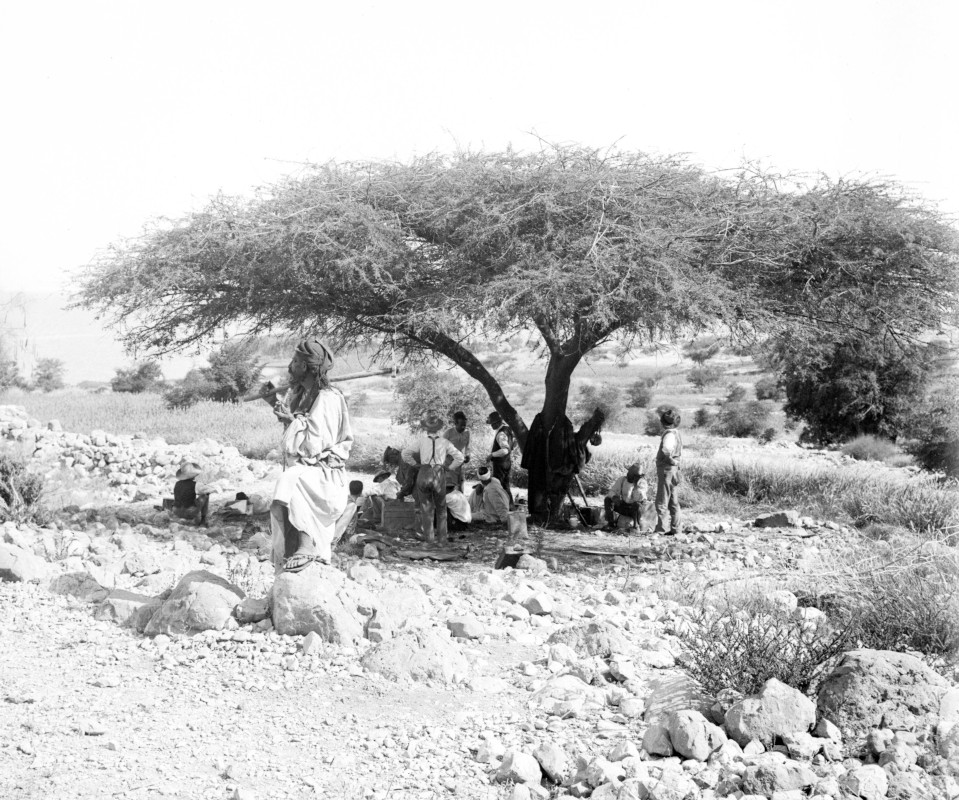
A shittim tree (which the source identifies as A. seyal) in En Gedi, the largest oasis on the western shore of the Dead Sea. G. Eric and Edith Matson Collection, US Library of Congress.
Accordingly, European Christians rarely believed in sacred trees and were responsible for felling religiously important oaks or pines that belonged to heathen tribes, or clearing their forests to devote them to agricultural use [36]. In many cases, sacred groves or trees were assimilated by building a church on the site, where divinity would be subsequently transferred, and the trees demoted to plain clerical property. Such strategies were an attempt to restart the cultural history of the land, and targeted above all sites with ancestral significance. In Europe, for example, the relative abundance of yew trees growing beside churches can be explained by their ancient connection to the ancestors. As Christians seized the land and claimed a monopoly over all relations with the dead (including their rites and places of their burial), they also ensured that the sacred trees associated with them remained in their possession, and at most were connected to saints or otherwise holy men. It’s worth noting how, when trees become property, our relationship with them becomes primarily instrumental, which can also happen if the one reason we would consider a tree as sacred or holy is because it has psychoactive properties.
A very similar process happened upon acquisition of the land by the faith of Islam, that refers to pre-Islamic Arabia as Jahiliyya—which literally means age of ignorance, or barbarism. Mainstream Islam left little room for trees to be sacred anymore. Related to our acacias, the story of al-‘Uzzā is a perfect example.
For the ancient Arabs, al-‘Uzzā (a feminine epithet meaning “the mightiest one”) [37] was one of the three daughters of Allah. A planetary deity representing Venus, the morning star, and also a goddess of power, might and love—which seems to relate her closely to the Mesopotamian Inanna-Ishtar, and later on to Aphrodite. Recently found evidence suggests she was already worshipped in the Late Bronze Age [38]. Al-‘Uzzā was very popular in pre-Islamic Arabia, but she was also present in Petra (in what is now Jordan) and possibly in the Sinai peninsula [39]; her tree was none other than the acacia.

The most important shrine of al-‘Uzzā in Arabia, which the goddess herself was believed to often manifest in, was a cluster of three acacia trees in Nakhlat ash-Shamiyyah, east of the town of Makkah (Mecca), where she was beloved. With the arrival of Islam, the eradication of previous divinities, including their sacred sites, was of course a high priority:

When the Prophet captured Mecca, he dispatched Khalid ibn-al-Walid saying, ‘Go to the valley of Nakhlah; there you will find three trees. Cut down the first one.’ Khalid went and cut it down. On his return to report, the Prophet asked him saying, ‘Have you seen anything there?’ Khalid replied and said, ‘No.’ The Prophet ordered him to return and cut down the second tree. He went and cut it down. On his return to report the Prophet asked him a second time, ‘Have you seen anything there?’ Khalid answered, ‘No.’ Thereupon the Prophet ordered him to go back and cut down the third tree. When Khalid arrived on the scene he found an Abyssinian woman with dishevelled hair and her hands placed on her shoulder[s], gnashing and grating her teeth. Behind her stood Dubayyah al-Sulami who was then the custodian of al-‘Uzza (…) [Khalid] dealt her a blow which severed her head in twain, and lo, she crumbled into ashes. He then cut down the tree and killed Dubayyah the custodian, after which he returned to the Prophet and reported to him his exploit. Thereupon the Prophet said, ‘That was al-‘Uzzā. But she is no more. The Arabs shall have none after her. Verily she shall never be worshipped again. [40]
The passage requires little to no commentary and exemplifies the procedure. Along with idols and wardens, sacred trees and groves in previous sanctuaries were burned or felled, and others were otherwise assimilated over time, often with the mediation of a holy man that, either in fact or fiction, left his footprint (or better yet, his grave) at their roots and allowed them to continue to be revered. The holier the man, the holier the tree [41], although some Islamic scholars made it clear that it was impossible for a tree to be sacred anymore [42]. Still, the scriptures do state that trees should be planted and protected; if only for the benefits they provide to the faithful, they are blessed. And certain Islamic branches, particularly Sufism, may have reinterpreted esoterically (and thus preserved) pre-Islamic sacred tree traditions under their view of nature as a reflection of the divine; not a resource to exploit, but a mirror of God. A view we can more easily adhere to.
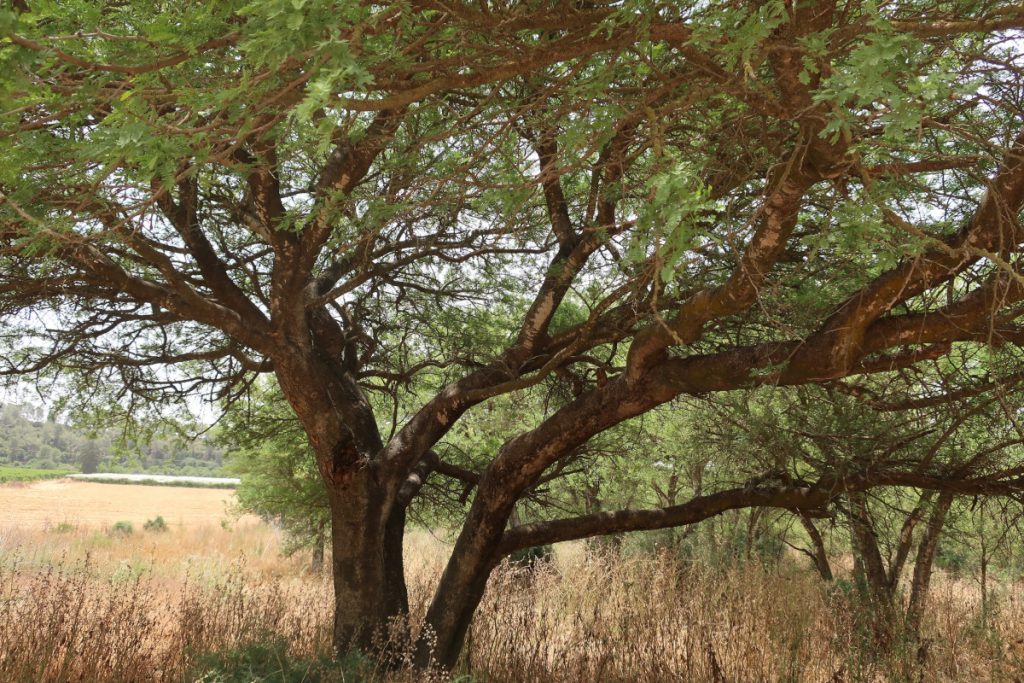
White acacia (Faidherbia albida) growing in the Elah Valley (Israel).
White acacia (Faidherbia albida) growing in the Elah Valley (Israel). Photo by David Bena (2024)
Finally, and in regard to ancient Judaism, most particularly after Exodus, the scriptures hardly leave any room for trees to be revered either—due to any psychoactive properties or otherwise. “The planting of groves is forbidden, as is the setting up of ašerah, the sacred tree or pole” [43]. And the treatment Israelites must dispense to rival prior sanctuaries, lest they remind them of other allegiances and heritage, is severe:
Ye shall utterly destroy all the places, wherein the nations which ye shall possess served their gods, upon the high mountains, and upon the hills, and under every green tree. And ye shall overthrow their altars, and break their pillars, and burn their groves with fire; and ye shall hew down the graven images of their gods, and destroy the names of them out of that place. [44]

Again, this was no war on trees; rather their submission, along with many other things, to a tribal doctrine that supersedes nature, which is rarely seen as a source of divinity anymore but rather as God’s property given in usufruct, a dividend paid to faithful shareholders. This vision is truly far from Amazonian worldviews, and does not quite align with the insights a healthy human would gain from serious dedication to entheogenic plant brews.

Even though, over two thousand years later, sacred trees are still not recorded in the Levant [45], some trees (no acacias, though) associated with shrines, tombs and other important sites have become shared sites of veneration utilised by Jews, Muslims, Druze, and Christians alike. New challenges and concerns about our environment can hopefully someday evoke commonalities much older (and perhaps much more important) than shared patriarchs and prophets, and encourage a practice closer to natural religion. This very wording I’m using, however, implies that we still have a long way ahead of us.
In our culture, the ayahuasca brew may be like the proverbial finger pointing at the moon, and a critical lesson we can learn from it is to be found in its custodians rather than in its pharmacology. Among the Tukano, the people in northwestern Brazil that allowed a European botanist to observe an ayahuasca ceremony for the first time, there is no word for “nature”. The same happens in several other languages in the Amazon. Amazonian indigenous worldviews do not have a concept of something called “nature” as a domain opposed to human culture. They explain to us how using a word like “nature” creates a false division between human beings and the environment. Recognising this false division may give us an answer to the question of what is sacred. Perhaps the solution is not in thoughtfully deciding what deserves to be sacred and why, but in accepting that the acacia is sacred because everything is.
The trees and other plants, the stars and the cattle were the materials that made up pre-Islamic thought. [it has been] shown that life in antiquity was deeper than what has flowed through our pens until now. However, no study so far has done justice to this heritage, which still lies buried in the sand. [46]

Acknowledgements

I would especially like to thank Rafael Sacramento, for his thorough review of recent academic papers discussing the phytochemistry of African and Middle Eastern acacias. His report provided essential (and sometimes, verbatim) considerations for this article, and above all allowed me to ensure that some conclusions are consistent with the currently available research data.

Also many thanks to Keeper Trout (https://troutsnotes.com) for kindly providing a copy of Wahba Khalil & Elkheir 1975, and overall for his outstanding work researching, curating and publishing information about plant sources of psychedelic compounds. His books, freely available, remain a peerless and invaluable reference source.

I would also like to acknowledge Andrew Dunn for a fascinating discussion about Peganum harmala and the Middle Eastern tryptamines hypothesis that ultimately encouraged the present essay.

References

1. Kyalangalilwa, Bruce & Boatwright, James & Daru, Barnabas & Maurin, Olivier & Bank, Michelle. (2013). “Phylogenetic position and revised classification of Acacia s.l. (Fabaceae: Mimosoideae) in Africa, including new combinations in Vachellia and Senegalia: Reclassification of African Acacia Species”. Botanical Journal of the Linnean Society. 172. 500-523. 10.1111/boj.12047.
2. Shanon, Benny (2008). “Biblical Entheogens: A Speculative Hypothesis”. Time and Mind: The Journal of Archaeology, Consciousness and Culture. Vol. I, Issue I, March 2008. 51-74
3. Luna, Luis Eduardo. “Vegetalismo. Shamanism among the mestizo population of the Peruvian Amazon”. Doctoral dissertation, Universitat of Stockholm, June 1986.
4. Samorini, Giorgio (2019). “Fake News About Ayahuasca’s Archaeological Antiquity”. In https://chacruna.net/fake-news-about-ayahuascas-archeological-antiquity/
5. https://ayahuasca-timeline.kahpi.net/
6. By the German chemist Julius Fritzsche in 1847.
7. Fitzgerald J, Sioumis A. (1965) “Alkaloids of the Australian Leguminosae. V. The occurrence of methylated tryptamines in Acacia maidenii F. Muell.” Australian Journal of Chemistry 18, 433–434.
8. Shanon 2008, 55
9. Shanon, Benny. The Antipodes of the Mind: Charting the Phenomenology of the Ayahuasca Experience. Oxford University Press, NY, 2002
10. Shanon 2008, 55
11. Ibid. 51
12. Ibid. 64-65
13. https://powo.science.kew.org/taxon/urn:lsid:ipni.org:names:60451308-2
14. Shanon mentions, in p.58, how he spotted a large patch of harmal near the Qumran caves, known for the discovery of the oldest manuscripts of the Hebrew Bible, and found the coincidence “most powerful”; it is worth noting, however, how P. harmala has been even used as a marker to decide promising sites for archaeological digs, since the plant is fond of growing close to human settlements, probably due to the deposits of phosphates accumulated after many generations of livestock, especially sheep and goats.
15. Shulgin, Alexander & Shulgin, Ann. TiHKAL, The Continuation. Transform Press, Berkeley, CA 1997. 265
16. NMT refers, as mentioned earlier, to N-methyltryptamine, that differs from DMT (N,N-dimethyltryptamine) in only one methyl group in the nitrogen. T refers to tryptamine, direct derivative of the amino acid tryptophan, and itself the metabolic precursor of NMT and DMT. The presence of T can be relevant in the search for either.
17. Shulgin, 266
18. Wahba Khalil SK, Elkheir YM. “Dimethyltryptamine from the leaves of certain Acacia species of northern Sudan”. Lloydia. 1975 Mar-Apr;38(2):176-7. PMID: 1055855.
19. Ibid. 177
20. To the 1.5 kg of leaves, one would need to add a sufficient dose of a MAO inhibitor like harmine or harmaline. But with such large amounts of plant material, practical preparation aspects would not be the only problem, since potentially toxic compounds such as cyanogenic glycosides in the plant would also be consumed together unless an extraction and purification were previously performed.
21. Sadgrove, Nicholas J. “Rumors of Psychedelics, Psychotropics and Related Derivatives in Vachellia and Senegalia in Contrast with Verified Records in Australian Acacia.” Plants (Basel). 2022 Dec 2;11(23):3356. doi: 10.3390/plants11233356. PMID: 36501395
22. Sadgrove, Nicholas & Wyk, Ben-Erik. (2025). “A survey of tryptamines in southern African Senegalia and Vachellia reveals N,N-dimethyltryptamine in Senegalia ataxacantha“. Biochemical Systematics and Ecology. 121. 104993. 10.1016/j.bse.2025.104993.
23. Dafni, Amots. “On the typology and the worship status of sacred trees with a special reference to the Middle East”. J Ethnobiology Ethnomedicine 2, 26 (2006). p2. https://doi.org/10.1186/1746-4269-2-26
24. Ibid. p4
25. Dafni, Amots. “The supernatural characters and powers of sacred trees in the Holy Land”. Journal of ethnobiology and ethnomedicine. 3. 10 (2007) 10.1186/1746-4269-3-10.
26. Shanon, 65
27. Homan, M. M. 2002. To your Tents, O Israel! The Terminology, Function, Form, and Symbolism of Tents in the Hebrew Bible and the Ancient Near East. Leiden:Brill.
28. Musselman, Lytton John. Figs, Dates, Laurel, and Myrrh: Plants of the Bible and the Quran. Timber Press, 2007. 40
29. Munzbergova, Zuzana & Ward, David. “Acacia trees as keystone species in Negev desert ecosystems”. Journal of Vegetation Science 13: 227-236, 2002
30. Khan ML, Khunbongmayum AD, Tripathi RS. “The Sacred Groves and Their Significance in Conserving Biodiversity: An Overview”. International Journal of Ecology and Environmental Sciences 34 (3): 277-291, 2008. National Institute of Ecology, New Delhi
31. Dafni 2006
32. Andersen GL, Krzywinski K. “Longevity and growth of Acacia tortilis; insights from 14C content and anatomy of wood”. BMC Ecology 2007, 7:4
33. Frese PR, Gray SJM: The Encyclopaedia of Religion: Trees. Edited by: Eliade M. 1995, New York, USA, Simon and Schuster and Macmillan, 15: 26-33.
34. Dafni 2006
35. Shanon, 66
36. https://arboriculture.wordpress.com/2016/10/09/christianity-religion-trees/
37. Healey, John F. The Religion of the Nabataeans, A Conspectus. Brill, The Netherlands, 2001. 114
38. Becking, Bob. “On the Origin of the Deity Uzzah”. Journal for Semitics Vol. 33, No. 1-2. December 2024, 1-16
39. Healey, 116
40. Healey, 118-119
41. Dafni 2006
42. Dafni, Amots. (2011). “On the Present-day Veneration of Sacred Trees in the Holy Land”. Folklore: Electronic Journal of Folklore. 48. 7-30. 10.7592/FEJF2011.48.dafni.
43. Grey, Peter. Lucifer: Princeps. Scarlet Imprint, London 2025. 50
44. Deuteronomy 12:2-3, King James Edition of the Bible
45. Dafni, A. “Rituals, ceremonies and customs related to sacred trees with a special reference to the Middle East”. J Ethnobiology Ethnomedicine 3, 28 (2007). https://doi.org/10.1186/1746-4269-3-28
46. Masarwah, Nader. “Religious Beliefs in Pre-Islamic Poetry”. Sociology Study ISSN 2159-5526. July 2013, Volume 3, Number 7, 531-542

Share: