“Do you remember the time when Silphion was so cheap?”
– Aristophanes, Knights, 890
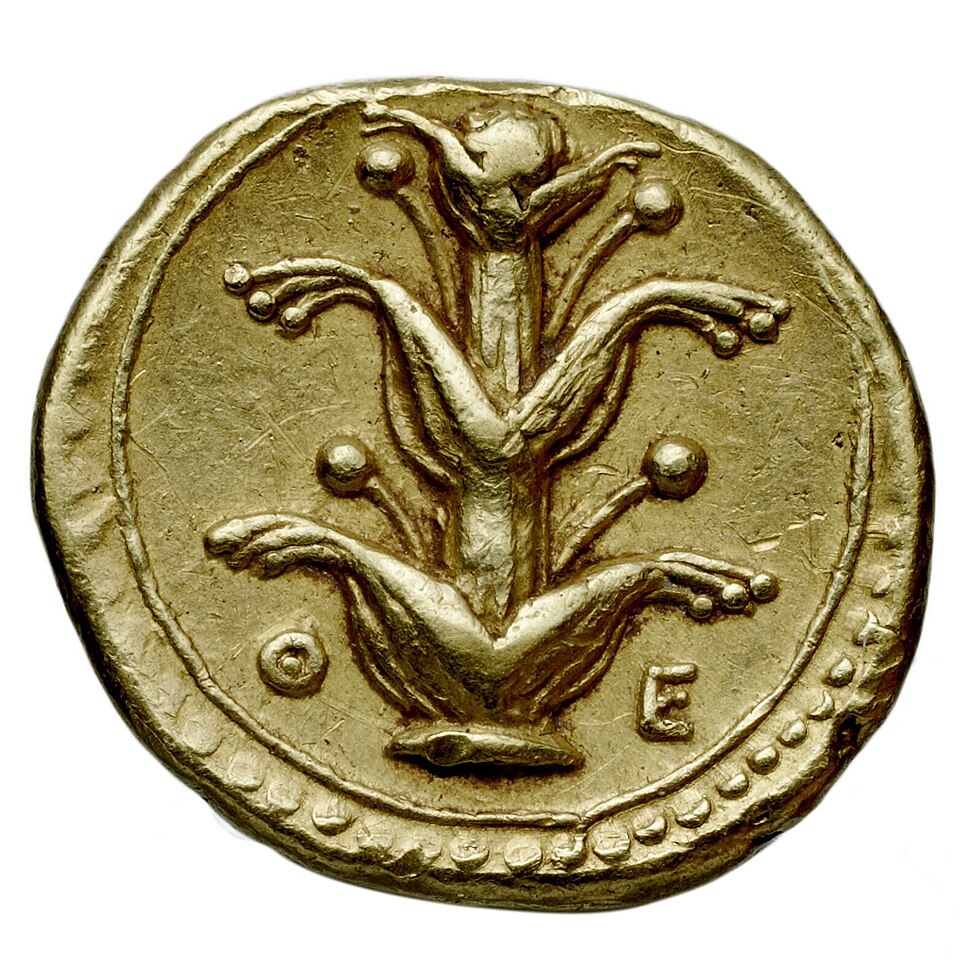
For centuries, on the coins minted in the most important Greek colony in Africa,
the protagonist was a plant.
This plant, called Silphion, was not only the source of one of the most prized spices in classical Greek (and later, Roman) cuisine. Its multiple medicinal applications earned it the status of a panacea, a cure-all that, some suggest, might have been used even as an aphrodisiac and contraceptive. It appeared in popular sayings and written plays, it was hoarded by Julius Caesar in his treasury, and it was discussed in works by great classical authors like Hippocrates, Herodotus, Dioscorides and Theophrastus, among others. According to Pliny, Silphion was “extremely famous for its prestige (…) important either for the daily use or like a medicine, and the whole plant is sold at the price of silver.” [1]
However, it has also been suggested that Silphion (or Silphium, if we prefer the Roman pronunciation) may be the first recorded case of a species that human impact drove to extinction. Historical accounts tell us that, by the first century CE, not a single Silphion plant could be found in Kyrenaica, the province in north-eastern Libya where it grew, and that flourished thanks to it. After centuries trading at high prices in Greek and Roman markets, the remarkable Silphion, “reckoned among the most precious gifts presented to us by Nature” [2], reputedly disappeared. Nearly two thousand years later, we keep trying to determine the botanical identity of the plant, the reason behind its vanishing –and even whether or not it did vanish completely.
The story of how the plant named Silphion became such a valuable commodity in classical antiquity begins on the Greek island of Thera –colloquially known today as Santorini– in the year 639 BCE.
After years of drought, famine and civil unrest in their land, a party of Therans led by their king set off on a journey to the mainland, to Delphi, seeking guidance. There, the god Apollo (who exerted considerable influence over wars, political shifts, colonisations and other key historical events in ancient Greece) provides counsel and prophecy through his spokesperson, the Pythia, priestess of the Temple of Apollo and known as the Oracle of Delphi. When the king of Thera asks her for advice on how to end their misfortunes, Apollo’s pronouncement is puzzling but clear: they must go to Libya and found a city there.
The king is old, and likely exhausted by the trip to Delphi, so he assigns the job to Aristaeus, one of his trusted men. But there’s just one problem: none of them have the slightest idea where Libya is.
All the inquiries, long sea expeditions, mishaps, comings and goings and even repeated oracle consultations that follow (surely hoping for more details, or perhaps a second opinion) make for a fascinating tale and, if we disregard the Therans’ distress during that time, quite an entertaining one too. But we’ll leave that tale to the historians. To cut a long story short, after finally making it to Libya and trying to settle in several places along the African coast without much success, the Greeks make friends with the locals, who at last lead them to a good spot. And so in 630 BCE, nearly a decade after receiving Apollo’s prophecy, Aristaeus founds Kyrene beside a spring which, as might be expected, is immediately consecrated to Apollo.
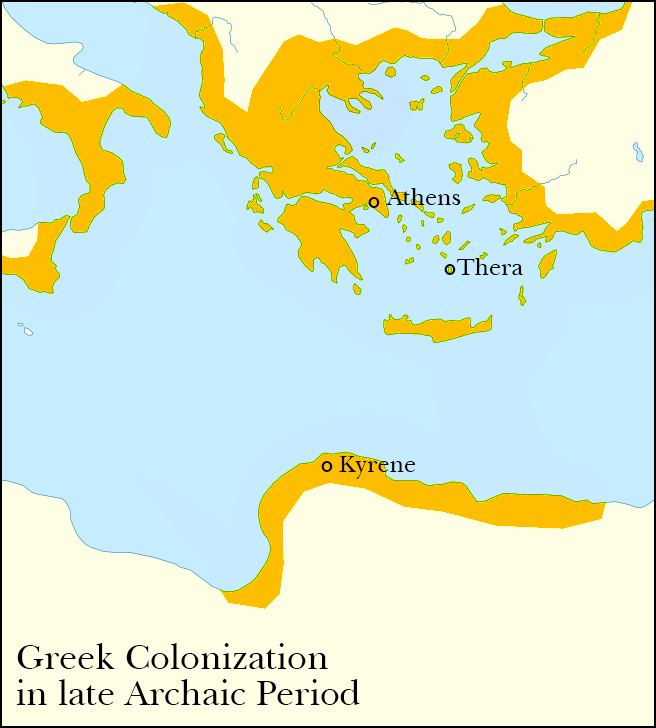
Aristaeus would enter history as Battos I of Kyrene, the first Greek king in Africa, a moderate and respected leader and founder of the Battiad dynasty, that ruled Kyrene for eight generations. During the sixth century BCE, Kyrene grew to become the most powerful city in the region, thanks to a high immigration flow and a generous, exceptionally fertile environment compared to the rest of the Libyan territory. Kyrene exported wheat and wool, and horses bred in the region were strong and healthy. They may well have become a symbol for the colony had Silphion not appeared.
We have an account of its apparition thanks to Theophrastus (371-287 BCE), who discussed Silphion (σίλφιον) at length. Named the “father of botany” and successor to Aristotle, when he was born the plant had been known and exported from the province of Kyrenaica for more than two hundred years. And indeed, in his treaty Enquiry into Plants he refers to Silphion as a species that, unlike many in his writings, requires no introduction. About its apparition, dated by Roman chroniclers at 617 BCE [3], Theophrastus tells us that
in some places they say that after rain a more singular abundance of vegetation has been known to spring up; for instance, at Kyrene, after a heavy pitchy shower had fallen: for it was under these circumstances that there sprang up the wood which is near the town, though till then it did not exist. They say also that silphion has been known to appear from some such cause, where there was none before. [4]
Some have embellished this account as a mysterious, sudden appearance of a mythical plant. A gift from the gods. From Apollo, the ancient Greeks could rightfully say. But regardless of divine influences, we know how colonists are prone to claiming the discovery of something that indigenous peoples have spent many generations living with, and we believe that this was the case with Silphion. The name itself implies that as well. Different analyses suggest that the word Silphion may have African (Berber), Semitic, or even ancient Egyptian origins –not Indo-European.[5]
But even without resorting to etymology, we have come to understand enough about plant cycles and propagation to guess that the “heavy pitchy shower” Theophrastus wrote about simply encouraged lots of dormant seeds (or roots) in the region’s microclimate, and made the plant proliferate enough to catch the colonists’ attention.
[Silphion] grew most profusely in a region of that country known as the Silphiofera, near the Gulf of Syrtis. There, where the plateaus along the Mediterranean coast rise as tiered highlands that receive considerably more rainfall than the deserts to the south, silphium thrived in a region of hilly and forested meadows. [6]
From the very first coins minted in Kyrene, in around 560 BC, the obverse bore the embossed picture of the Silphion plant, which kept appearing on the majority of coins produced in the city. A proverb held that something could be as valuable “as the Silphion of Battos.” [7]
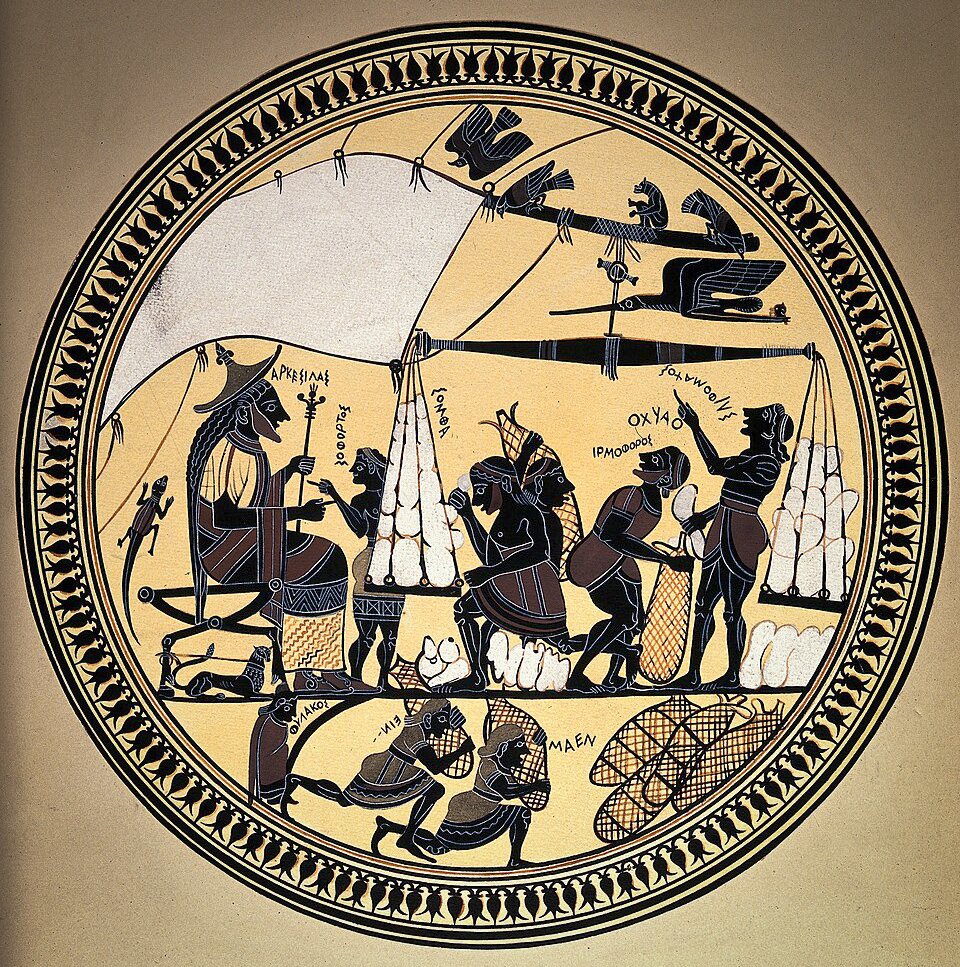
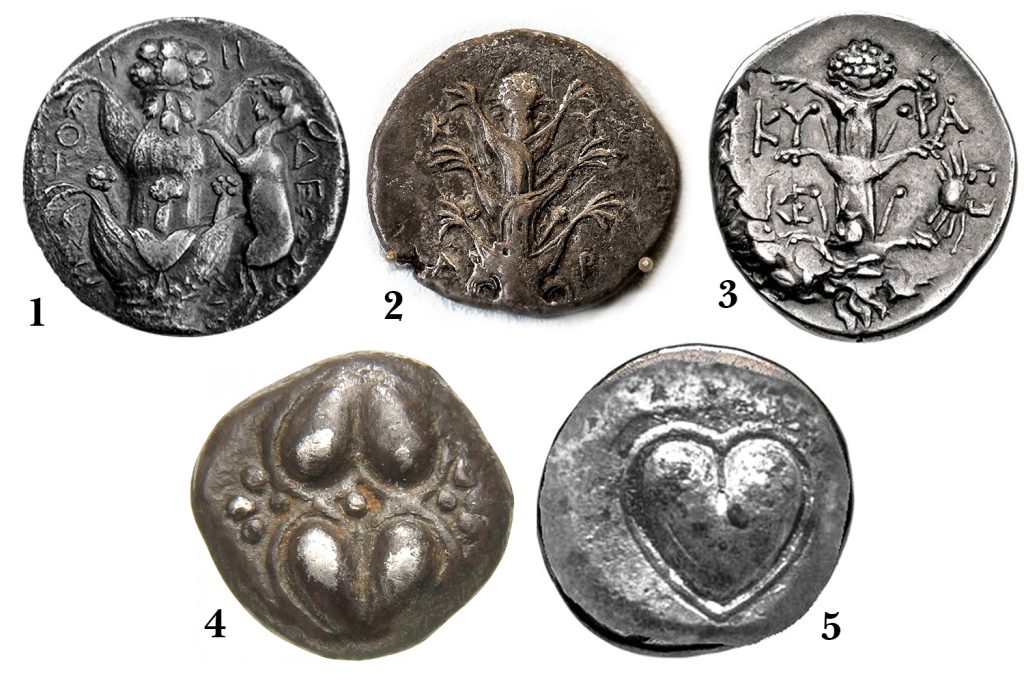
Aside from its representations in coins, we have a description of the plant from Theophrastus:
Silphion has a great deal of thick root; stalk is like ferula in size, and is nearly as thick; the leaf, which they call maspeton, is like celery. It has a broad fruit, which is leaf-like, as it were, and is called the phyllon. The stalk lasts only a year, like that of ferula. Now in spring it sends up this maspeton, which purges sheep and greatly fattens them, and makes their flesh wonderfully delicious; after that it sends up a stalk, which is eaten, it is said, in all ways, boiled and roast, and this too, they say, purges the body in forty days. [8]
Silphion representations and descriptions fit the genus Ferula, in the Apiaceae (formerly Umbelliferae) family. Silphion was thus related to fennel, celery and angelica, among others. All parts of the plant were harvested and used, including the stalk, seeds and root. And while stalks and leaves were enjoyed as a vegetable, the greatest treasure lay in Silphion’s sap, a pungent juice [9] obtained by tapping around the crown of the plant –the area where root and stalk meet– and that was left to harden until it could be collected as a resin. The Romans, who later took Silphium to new heights both as a delicacy and as a commodity, had different names for virtually every part of the plant [10], and they called this resin laserpitium [11], or laser for short. This resin would likely be a rich collection of the flavour and properties of the plant. The fact that the process to obtain it at its most fragrant and powerful, probably during its flowering cycle, could easily result in the death of the plant before producing seeds, was an inconvenience; the fact that apparently Silphion could not be cultivated as a crop was a much more serious one.
Theophrastus, again our most reliable and direct source for the botanical aspects of the story, tells us that Silphion avoided cultivated ground and that multiple attempts to cultivate it in other places had failed [12]. The plant was thus additionally valuable and strongly connected to Kyrene. But above all, Silphion became valuable because it seduced people on account of its fragrance and many applications.
Food, Medicine and Sex
As a spice, Silphion was a favourite addition in classical antiquity cuisine, both in Greek and Roman dishes like Cabbage the Athenian Way, or Parthian Chicken. It was also widely used to treat indigestion, even though overindulging would cause what Galen called arida cholera [13], which we know better as flatulence [14]. Surprisingly, its flavour was probably similar to garlic. A substitute for Silphion that became increasingly used as the Kyrenaic product grew scarce was asafoetida (Ferula asa-foetida), a resin used in Indian cuisine –and key ingredient in Worcestershire sauce– that shows a spectrum of sulphurous compounds. Asafoetida was considered inferior by ancient sources, but nonetheless it borrowed the name and was called Median or Syriac Silphion. The difference between the scent of the Silphion from Kyrene (described as extremely pleasant) and the asafoetida resin (that has been called “the devil’s dung”) is something we can only wonder about. Dioscorides wrote that Median and Syriac Silphion were not only weaker in strength, but that they also had “a more poisonous smell”. [15]
But there’s a good chance that the plant’s success owed even more to its virtues as a medicine than as a food. In any case, we are more likely to make that distinction than the ancient Greeks, who drew no clear line between food and medicine and saw them both as belonging to a fluid continuum –a flexibility that, perhaps, also influenced what bore the name of Silphion.
If we look at the most important ancient sources, Silphion’s fame as a plant that could treat almost anything does not seem exaggerated. Hippocrates, the Greek father of medicine, brings it up in his studies –particularly in its juice form– as useful for treating lung and “side ailments”, dropsy, liver diseases, typhus, quartan fever (a form of malaria), bowel dysfunction and problems in the rectum, among others. Later, Dioscorides includes a report about Silphion in De Materia Medica, also recommending its use to cure bruises, ulcers, bites and contaminated or otherwise infected wounds, to cast off parasites, and diluted as a mouthwash and for gargling. Even Galen, the most famous doctor in the Roman Empire, referred to the “remarkable properties” of Silphion and also included it in preparations to treat sciatica and pain in the diaphragm, teeth or ears [16] In the right amount, he advised its use in colic and irritation of the digestive tract. Most of the recommended medical applications of Silphion in classical antiquity involved very moderate use of the plant resin, often an amount the size of a pea or a bean. [17]

There are other alleged therapeutic uses of the plant that deserve a special mention, if only because many modern articles highlight them: applications in sexual and reproductive health. A simple internet search will produce multiple results that describe Kyrenaic Silphion not only as a mysterious and valuable plant that seemingly went extinct, but also as a potent aphrodisiac and contraceptive in ancient Greek and Roman times. Some of these claims have been amplified in the last decades and are, in my opinion, questionable.
The tantalising hypothesis that Silphion owed much of its success to sexual and reproductive applications does not appear to be well-founded, if we look at sources from the same period. Both Hippocrates and Dioscorides named different plant materials that could be used as an aphrodisiac, but neither of them includes Silphion in this category. And while it is true that, among many other applications, Hippocrates also recommended the use of Silphion in a preparation to purge the uterus after a miscarriage, he also suggested other plants for the same purpose. Recent articles have also referenced Pliny’s recommendation to use Silphion to induce menstruation as proof of its importance as a contraceptive in antiquity, overlooking the fact that Pliny also recommended a dozen other plants in the same terms. So –where does the hypothesis come from?
A source seems to be Soranus, a Greek physician particularly known for his work in gynaecology. Soranus includes “Kyrenaic juice” in a preparation used for birth control. The problem is, he described the recipe in the second century CE, while reports that had declared the Silphion of Kyrene extinct were written in the first. If that was the case, then this “Kyrenaic juice” was not our Silphion’s. Nearly a millennium later, Avicenna, the well-known physician and philosopher of the Muslim world, attributed aphrodisiac properties to a Silphion, but we must assume he was referring to a different plant [18]. Regardless, modern authors have tried to pursue the idea. The always interesting John M. Riddle gave Silphion a prominent role as a contraceptive in classical antiquity in one of his articles [19]. While his work to reclaim the traditional use of plants for this purpose and to highlight the ethical contrasts in these matters between ancient and modern times was important and necessary, the arguments he proposed to back up the case for Silphion are not convincing.
There is an interesting piece of evidence, though, that seems to encourage the idea that Greeks connected Silphion to sexual and reproductive health: the iconic leaf-like, heart-shaped fruits/seeds reproduced on coins. But the fact that the fruit or seed of a plant became iconic (the way the cannabis leaf is now, for instance), and that this icon reads like one we use today, does not imply that the ancient Greeks would read it the way we do [20]. It does not follow either that our modern Valentine heart symbol originated from that icon. The idea that the heart-shaped fruit of Silphion inspired the modern heart symbol –a very pleasant idea, at first– may be caused by our cultural perspective, and not so much based on historical evidence. The genealogy of the symbol is not clear.
There have been other interpretations of the heart-shaped fruit and its meaning to ancient Greeks. Some authors have even considered the plants and fruits on coins as part of a marketing strategy worthy of our times, seeing in the outline of Silphion a suggestive phallic symbol, and the fruit as the “result of a conscious effort to mimic testicles” [21]. They partly base their suggestion on old reports that say that no plants in the Apiaceae family have seeds shaped as a heart, but I can say this is false –I have seen a type of fennel with clearly heart-shaped seeds in the Spanish Pyrenees.
This is not to say that Silphion’s virtues as a warming agent that promoted circulation and thus could contribute to sexual arousal (the way garlic or onions do), or its reported usefulness to purge the uterus and facilitate menstruation (like several other plant species), had no part at all in its success. But trying to represent Silphion as a staple for sexuality in classical antiquity seems far-fetched and is likely the result of confirmation bias in the work of some researchers –or it is simply that in our culture and in recent times in particular, sex sells. [22]
The Vanishing
Eventually, Kyrenaic Silphion became scarce. And as demand outgrew supply, substitutes progressively took its place in the market. Pliny, in his Natural History (published around 77-79 CE), writes:
For these many years past, however, it [Silphion] has not been found in Cyrenaica, as the farmers of the revenue who hold the lands there on lease, have a notion that it is more profitable to depasture flocks of sheep upon them. Within the memory of the present generation, a single stalk is all that has ever been found there, and that was sent as a curiosity to the Emperor Nero. [1]
Some recent texts add that Nero ate it, something that to my knowledge was never reported, but that makes the story even more compelling. There is something memetic in the image of a decadent and cruel emperor gulping down the last vestige of a natural treasure. And maybe Nero eats it just as he picks up his lyre and takes his seat to watch Rome burn, if we want to make the story even more memorable. The fact is that Pliny was not always picky about his sources, so maybe he just heard that little fable about Nero and the last Silphion plant somewhere and adopted it as an allegory.
What we know with certainty is that, from 250 BCE onwards, the Silphion of Kyrene began to disappear from coins, and it was apparently extinct by the first century CE.
Ancient chroniclers already proposed several explanations. Strabo, the Greek historian (64 BCE-21+ CE) said that hostile barbarians razed the fields where Silphion grew. Pliny (and multiple authors after him) attributed it to changes in policies brought by profit-driven Roman governors, who would have changed harvest management, or given shepherds the land where Silphion thrived, to be used as pasture for sheep or goats. It is difficult to understand, however, why governors would replace a valuable and increasingly scarce product with wool and meat in order to increase region revenue –and thus their own wages. This seems especially paradoxical if the meat’s distinctive flavour came precisely from livestock feeding on Silphion stalks and leaves.
We have been asking some of our favourite questions for centuries. What caused it? Who was to blame? Careless shepherds? Angry barbarians? Relentless tax collectors? It is seldom that simple. Human growth –including both survival and greed, not always clearly distinct– has traditionally been a cause for accelerated extinction. This is something we certainly know better than Pliny ever did, and a recent study explored it to give us an answer:
What we know of the famed silphium plant in the modern day, from characteristics described by our ancient sources, reveal a plant that only germinated within a remarkably narrow band of geography in which a particular microclimate had been sustained. The human-induced change of this microclimate, therefore, had an outsized impact on the ability of silphium to germinate within its native range while cropland expansion to the north prevented the species from migrating to more suitable environments. [23]
Perhaps population growth pushed back farmlands and eroded the soil, grazing pressure on Silphion increased, governors failed to understand ecosystem needs and balances, and barbarian raids played only a minor role. Silphion was already fragile and could not endure the strain.
The Name
So the Silphion of Kyrene seemingly disappeared –but not its name. Different plants, like the aforementioned Ferula asa-foetida, inherited it. And others would follow. During European Late Antiquity and the Middle Ages, our perception of the natural order did not leave much room for a plant to simply vanish; the neoplatonic concept of the Great Chain of Being, the division of all life and matter, was considered by Christians during the Middle Ages as an absolute order decreed by God. A clear hierarchy was established: rocks, plants, animals, man, angels and God –in this precise sequence. Creation was stable and continuous, and parts of nature could not just appear or disappear. At least that was the theory, or the metaphysical dogma. Of course, this would invite scholars to find “Silphion” elsewhere, and that is what happened. Not only in Syria or Persia –plants in places as distant as Germany, Italy and France were called Silphion, or their resin laserpitium.
Vera Keller, in her analysis of Early Modern sources [7], elaborates on how a complete extinction was an uncomfortable idea, an elephant in the room that took centuries to acknowledge. It was not until the seventeenth century that scholars started to consider that maybe Kyrenaic Silphion was not waiting to be found somewhere, ready to sprout again, but that it simply could not be recovered. Some things might be forgotten, but they could perhaps be re-created. Silphion, however, was perhaps neither forgotten nor hiding, but lost, and we could not bring it back.
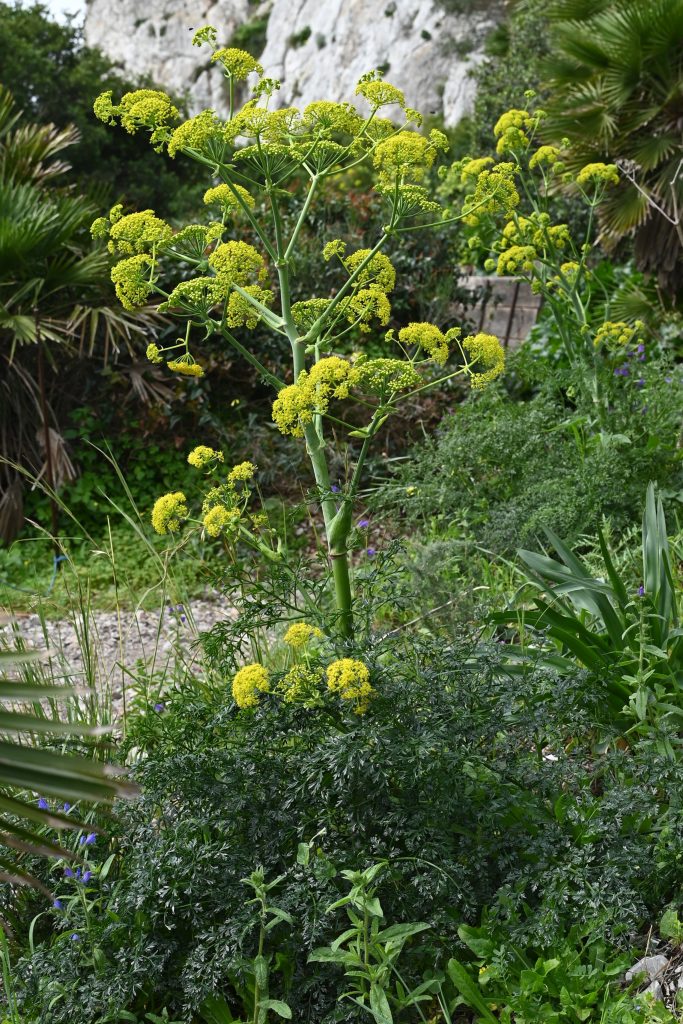
From a botanical perspective, of course, there have been multiple attempts to identify an extant, modern species like the Kyrenaic Silphion. Several members of the Apiaceae family, belonging principally to the genera Ferula and Thapsia –like Ferula tingitana, a relatively rare species that can still be found in the region of Libya where Silphion grew– have been suggested. However, no satisfactory match has been found. Attempts to identify a modern species like Kyrenaic Silphion have failed, or at least have not been conclusive.
Recently we saw a remarkable new episode in the history of the name of Silphion. Mahmud Minski, from the Department of Pharmacognosy at the Istanbul University, published an experimental study that proposed Ferula drudeana, a species endemic to locations near formerly Greek villages in Anatolia (modern Turkey), as a candidate for the lost Silphion, or at least a close relative of it. In the conclusion, he suggests
Thanks to the ancient smugglers who presumably have brought the seeds of the silphion plant to Anatolia, this precious species may have survived the extinction that its relatives had suffered in the Kyrenaic region of Libya ca. 2000 years ago. [24]
Analysis and experiments say F. drudeana is a fragrant plant, rich in medicinal compounds, that can also be used as a condiment, and obviously belonging to the same family as Kyrenaic Silphion, The story even made it to the National Geographic magazine [25]. Sadly, we do not have permission to reproduce the beautiful pictures of the plant included in their article, but that seems to be where their identity mismatches. The botanical description left by Theophrastus describes the leaves of Silphion as “looking like celery”. I am surely not the first to point this out, but the leaves of F. drudeana look nothing like celery. Neither do its seeds have the iconic leaf/heart shape we’ve seen. Ferula drudeana is a very interesting plant that deserves attention and preservation efforts, and it is certainly also a more or less close relative of the Kyrenaic Silphion. But whatever their kinship is, this “Silphion rediscovered” (as some sources have heralded it) and the Silphion of Battos are not the same.
“Language can speak of both the non-existent and the destroyed”, Umberto Eco reminds us in his postscript to The Name of the Rose. Silphion may be a bit like royal purple, the colour worn by kings and Roman patricians, expensively produced two thousand years ago from the secretions of certain sea snails in distant lands. Registered in chronicles and treaties, remembered, searched obsessively, even emulated, but surviving only in name.
References
Source of images not credited in their caption: Wikimedia Commons, CC 4.0 license or Public Domain.